
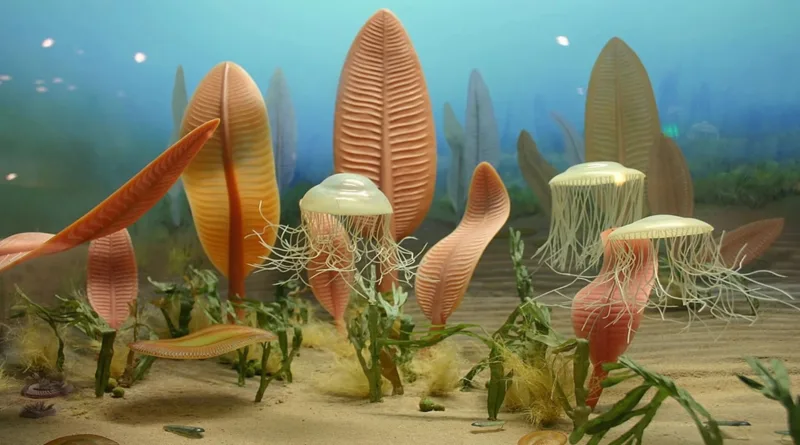
Scientists Finally Explain Earth’s Strangest Fossils — The Ediacara Biota
A journey into the deep past, where a long‑hidden chemical secret finally reveals how Earth’s earliest soft‑bodied creatures survived in stone.
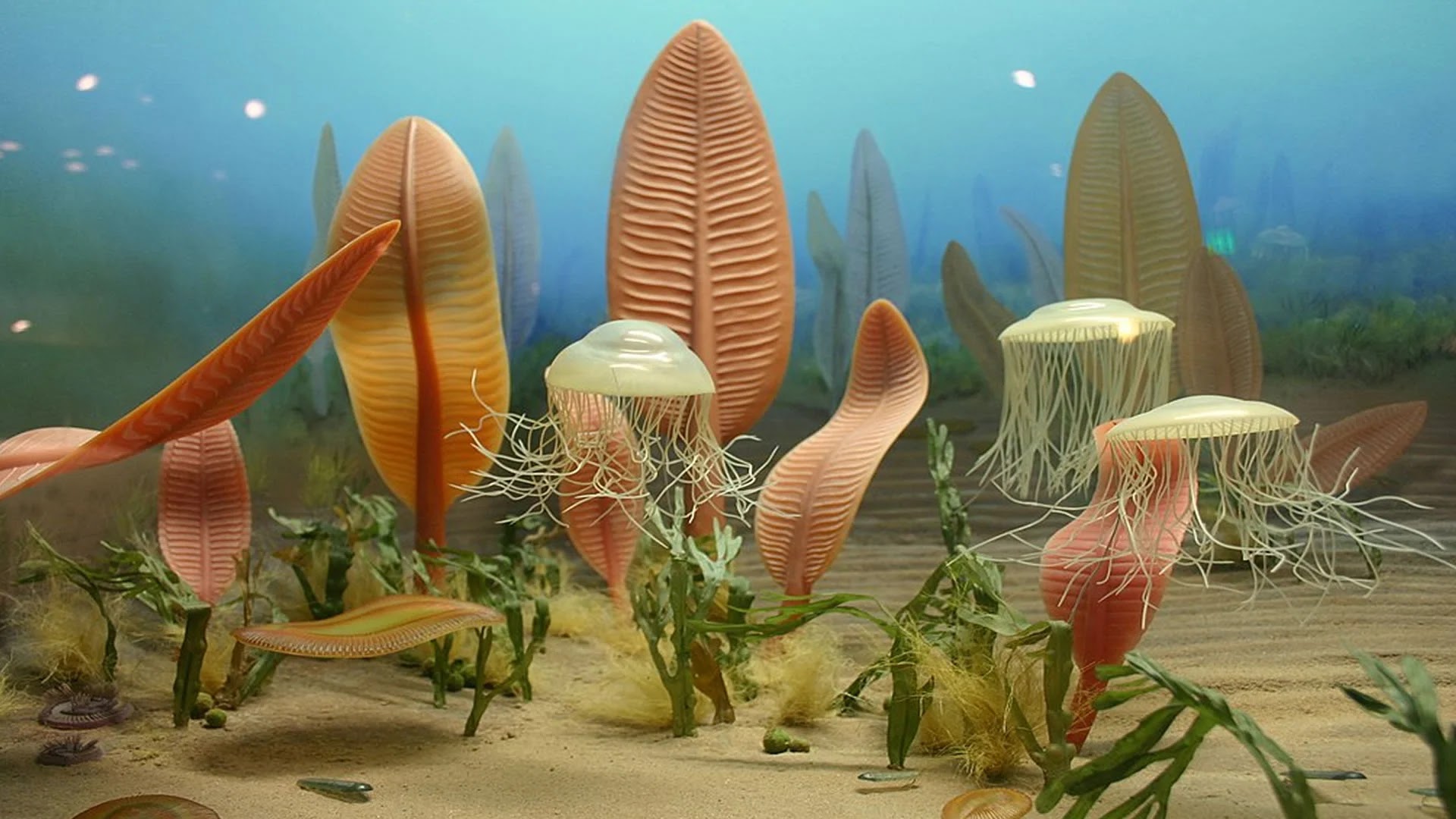
For more than a century, the Ediacara biota have stood like whispers from a forgotten world, soft‑bodied organisms pressed into sandstone with a clarity that should have been impossible. These creatures lived roughly 570 million years ago, long before shells or bones or any of the hard structures that normally survive the passage of geological time. By every rule of preservation, they should have vanished without a trace. And yet, their delicate forms remain, etched into rock as if the Earth itself refused to let them disappear.
They are strange, almost dreamlike beings. Some spread across the stone like quilted discs, others unfurl in fern‑like patterns, and a few radiate outward in shapes that resemble nothing alive today. They belong to a world that predates animals as we know them, a world where life was still experimenting with form and function, testing the boundaries of what multicellular existence could be. Their survival in the fossil record has always been a paradox, a scientific riddle that resisted every attempt at explanation.
Now, at last, the mystery has begun to dissolve. New research reveals that the secret to their preservation lies not in the organisms themselves, but in the chemistry of the ancient oceans that once covered them. The seawater of the Ediacaran period carried an unusual mix of dissolved elements, a chemical cocktail rich in reactive ions that no longer exist in such abundance today. When these soft‑bodied creatures died and settled onto the seafloor, the surrounding water triggered a rapid transformation. Minerals precipitated out of the seawater and formed a thin, protective cement around their bodies, locking the surrounding sand into place before decay could erase their outlines. In a sense, the ocean became a sculptor, capturing the final moments of these organisms with extraordinary precision.
This process turned the seafloor into a natural archive, preserving not just isolated specimens but entire communities. It reveals a world that was far more vibrant and complex than scientists once imagined. The Ediacaran landscape was a place without predators, without shells, without the frantic competition that would later define the Cambrian explosion. Life spread across the seabed in broad, interconnected mats, absorbing nutrients directly from the water, drifting gently with currents, and forming ecosystems that feel both alien and strangely serene. Understanding how these fossils formed allows researchers to reconstruct this ancient world with new clarity, illuminating the earliest chapters of complex life on Earth.
The implications reach far beyond geology. For decades, scientists believed the Ediacaran fossil record was a rare accident, a lucky snapshot of a world that should have been lost. But the new findings suggest that the conditions for preservation may have been widespread, meaning the Ediacaran biosphere was richer, more diverse, and more ecologically structured than previously thought. It forces a reconsideration of how life evolved, how ecosystems functioned before animals developed mobility and predation, and why these organisms eventually disappeared just before the Cambrian explosion reshaped the planet.
What emerges is a portrait of a world both fragile and enduring. The Ediacara biota remind us that life’s story is not a straight line but a tapestry woven from experiments, transitions, and forgotten possibilities. Their fossils are not just remnants of ancient organisms; they are messages from a time when Earth was young and life was still learning how to build itself. Thanks to this breakthrough, the Ediacaran world is no longer a silent enigma. It is a landscape we can finally begin to understand — a place where soft‑bodied creatures once drifted across ancient seas, leaving behind the faint, beautiful signatures of life’s earliest ambitions.
Editorial Disclaimer
This article reflects publicly available scientific research on Ediacaran fossil preservation. It is intended for informational and editorial purposes only and should not be taken as geological guidance, scientific certainty, or a definitive interpretation of early Earth ecosystems. Paleontological understanding evolves as new evidence emerges. Readers seeking the most current scientific details should consult peer‑reviewed studies and official research publications.