
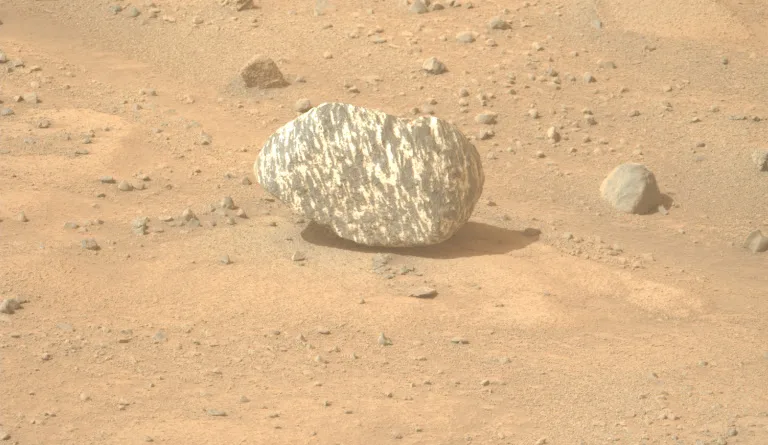
Strange White Rocks on Mars Reveal Evidence of Millions of Years of Rain
A discovery that reshapes our understanding of Mars — and hints at a climate shaped by millions of years of rain.

Mars has always been a planet of contradictions — dry yet carved by rivers, frozen yet shaped by ancient floods. But NASA’s Perseverance rover has now uncovered something that pushes the mystery even further: bright white, aluminum‑rich rocks that look strikingly similar to kaolinite, a clay on Earth that forms only after millions of years of intense, persistent rainfall in warm, humid environments.
The discovery is startling because it challenges the long‑held view of Mars as a world that was cold, briefly wet, and never truly Earth‑like. Kaolinite is not the product of a passing shower or a short‑lived lake. It requires time — vast stretches of it — and a climate capable of sustaining continuous water flow. If the Martian rocks truly mirror this mineral, then the planet’s early environment may have been far wetter, warmer, and more stable than scientists believed.
Perseverance found these pale, almost luminous rocks in Jezero Crater, a region already known to have hosted an ancient river delta. But the aluminum‑rich signature adds a new layer to the story. It suggests not just the presence of water, but long‑term weathering, the kind that reshapes landscapes and alters planetary chemistry. On Earth, kaolinite forms in tropical regions where rainfall is relentless and temperatures remain high. To find its Martian analogue hints at a climate that could have supported not just water — but potentially life.
This discovery forces scientists to rethink the timeline of Mars’ transformation. If the planet once experienced millions of years of rainfall, then its shift into the cold desert we see today must have been more dramatic and more recent than previously assumed. It also raises new questions about where ancient water might have gone — into the ground, into the atmosphere, or locked away as ice.
For now, Perseverance continues its slow, deliberate exploration, sampling rocks that may hold the chemical fingerprints of a lost Martian climate. Each discovery adds another piece to a puzzle that is beginning to look less like a barren world and more like a planet that once breathed with storms, rivers, and rain.
Editorial Disclaimer
This article summarizes publicly available scientific findings from NASA’s Mars missions. It is intended for informational and editorial purposes only and should not be interpreted as scientific guidance, geological analysis, or a definitive conclusion about Mars’ ancient climate. Planetary research evolves as new data emerges. Readers should consult NASA’s official releases and peer‑reviewed studies for the most current information.