

The Whispering Stone: Earth’s Unexpected Celestial Companion
It began, as many cosmic revelations do, with a flicker—an anomaly in the sky, barely perceptible, like a whisper against the roar of the universe. Astronomers at the University of Hawaii, scanning the heavens with instruments tuned to the faintest echoes of motion, noticed something peculiar: a small object, no larger than a modest building, moving in a rhythm that mirrored Earth’s own. It wasn’t a comet, nor a rogue asteroid on a collision course. It was something stranger. Something quieter. Something that had been with us for decades, unnoticed.
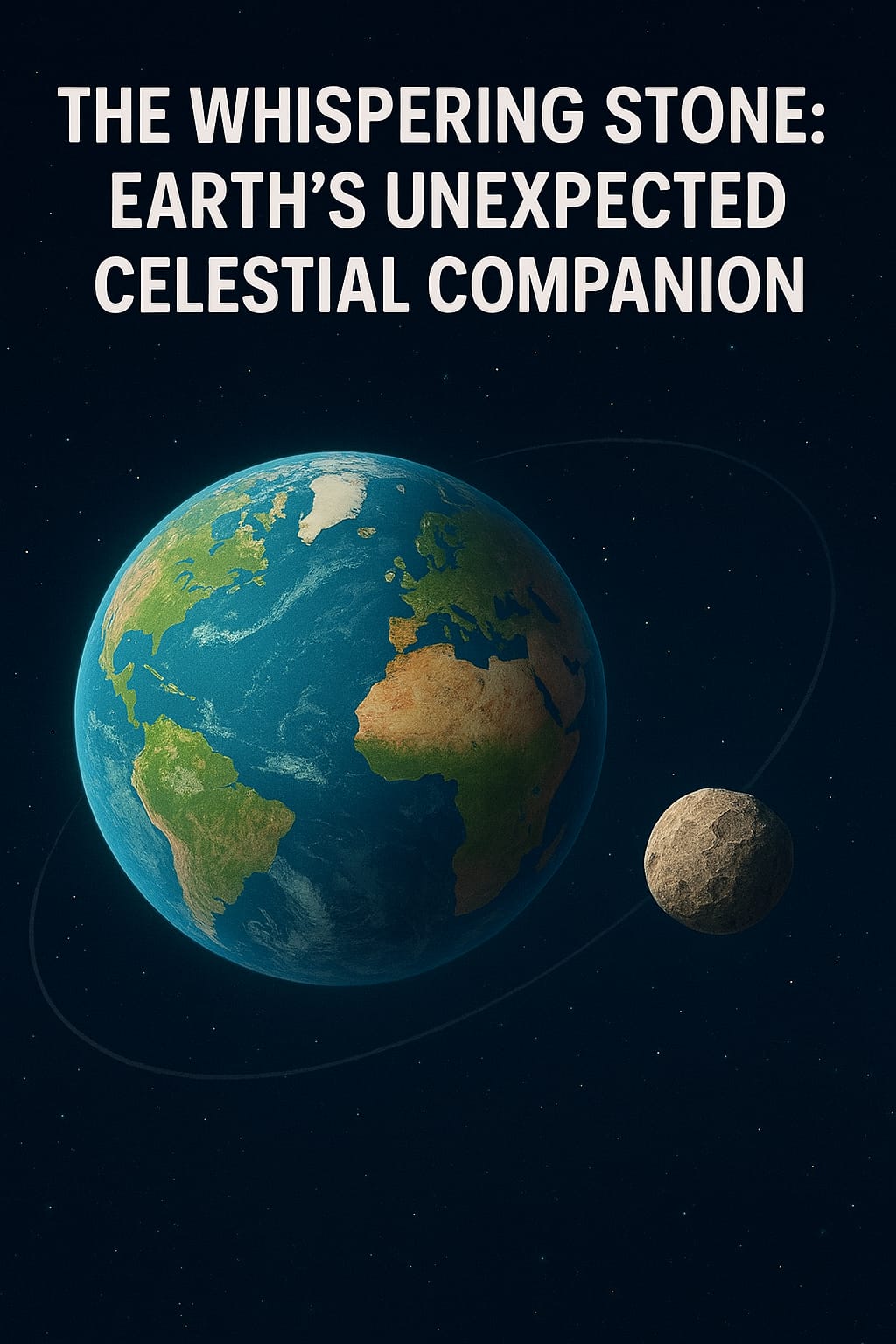
NASA has now confirmed what the data suggested: Earth has a new companion. Not a second moon in the romantic sense, but a quasi-moon—a celestial drifter named 2025 PN7, caught in a gravitational ballet with our planet. It doesn’t orbit Earth directly, but its path around the Sun is so similar to ours that it appears to loop around us, like a shadow dancing just beyond reach. And if predictions hold, this silent partner will remain with us until the year 2083.
The discovery of 2025 PN7 is not just a scientific footnote—it’s a reminder of how much mystery still lingers in the space just beyond our atmosphere. For nearly sixty years, this asteroid has been trailing Earth, invisible to the naked eye, too small and dim to stir public imagination. Yet its presence is real, and its orbit is stable. It is, in every sense, a ghost moon—an echo of our journey through the cosmos.
Unlike our true Moon, which dominates the night sky and pulls at the oceans with its gravity, PN7 is a quiet observer. Measuring between 18 and 36 meters in diameter, it poses no threat, no spectacle. It will not eclipse the Sun or inspire lovers to gaze upward. But it will remain, faithfully tracing our path, a cosmic understudy in Earth’s celestial theater.
The term “quasi-moon” might sound like science fiction, but it’s a recognized phenomenon. These objects are not bound to Earth by gravity, yet they move in such harmony with our orbit that they seem to circle us. They come and go, temporary companions in the vast loneliness of space. PN7 is one of the few known quasi-moons, and its long tenure makes it particularly intriguing to scientists studying orbital dynamics and the subtle gravitational interplay between Earth and nearby objects.
Social media, predictably, erupted with excitement and confusion. “Earth has two moons!” the headlines blared. But NASA was quick to clarify: PN7 is not a moon in the traditional sense. It’s a visitor, not a resident. A mimic, not a mirror. Still, the poetic allure of a second moon—however fleeting—captured imaginations around the world.
For those who look to the stars not just for data but for meaning, PN7 offers a metaphor. It is the quiet companion we never knew we had. The reminder that even in the most familiar paths, there are secrets. That Earth, for all its noise and motion, is part of a larger dance—one that includes silent partners and unseen rhythms.
As we move through the decades ahead, PN7 will continue its watch. It will rise and fall in our skies, invisible but present. And in 2083, it will drift away, its orbit diverging, its time with us complete. Perhaps another quasi-moon will take its place. Perhaps not. But for now, Earth is not alone.
In the end, the story of 2025 PN7 is not just about astronomy. It’s about attention. About the things that move with us, unnoticed. About the companions we overlook. And about the beauty of discovering, even after all this time, that the sky still holds surprises.