

Ultracold particles are revealing cracks in our understanding of relativity—ushering in a new frontier where quantum mechanics and Einstein’s legacy collide.
In a dimly lit lab, where lasers sculpt invisible landscapes and atoms drift in near-absolute stillness, physicists are orchestrating a quiet revolution. Their instruments don’t roar—they hum. Their discoveries don’t explode—they whisper. And yet, the implications echo across the foundations of modern physics: ultracold particles may be challenging the very fabric of relativity itself.
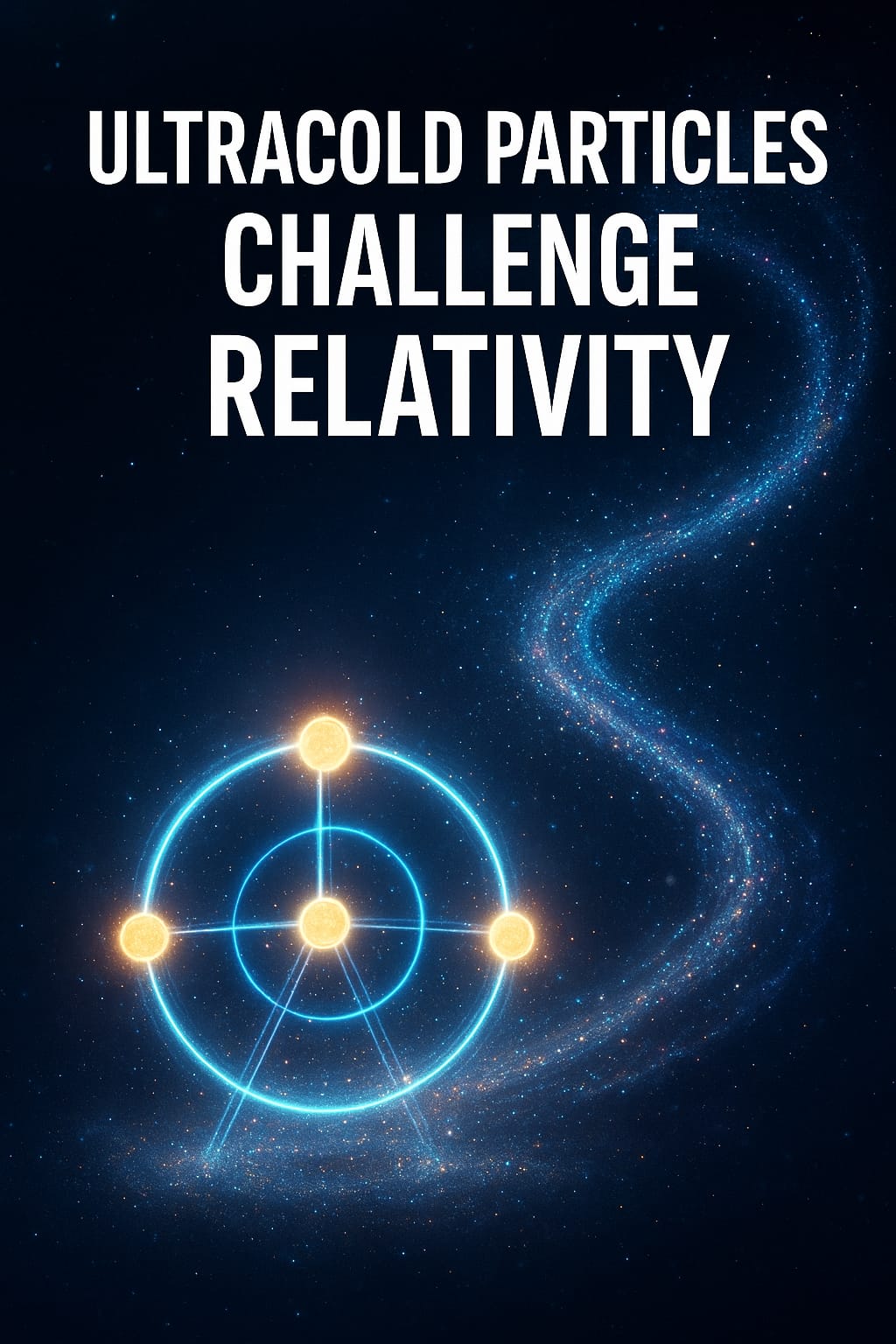
At the heart of this unfolding story are atoms chilled to billionths of a degree above absolute zero. In this frozen realm, motion slows, quantum effects bloom, and the rules we thought were unshakable begin to bend. Researchers have begun trapping these particles in rotating light structures—nicknamed “atomic Ferris wheels”—to test how time behaves when quantum mechanics and relativity intersect.
Einstein’s theory of relativity tells us that time dilates for objects in motion. A clock aboard a speeding spaceship ticks slower than one on Earth. But what happens when that clock is a quantum particle, suspended in a light-made carousel, spinning at speeds where quantum uncertainty reigns? That’s the question physicists are now daring to ask.
The experiments are elegant in their simplicity and profound in their ambition. By observing how ultracold atoms behave when rotated or accelerated, scientists can probe whether time dilation holds true at quantum scales. Early results suggest subtle deviations—tiny anomalies that hint at a deeper, more complex relationship between motion, time, and quantum state.
But this isn’t just about testing Einstein. It’s about building bridges between two towering theories: general relativity, which governs the cosmos, and quantum mechanics, which rules the microscopic. For decades, these frameworks have stood apart, brilliant but incompatible. Ultracold particles may be the key to reconciling them—not through brute force, but through quiet observation.
Beyond the lab, the implications ripple outward. If quantum particles experience time differently, could this reshape our understanding of black holes, where gravity warps time to extremes? Could it inform quantum computing, where time-sensitive operations hinge on coherence and entanglement? Could it even hint at new physics—undiscovered laws that lie just beyond our current reach?
For now, the answers remain elusive. But the journey has begun. In the silence of ultracold chambers, where atoms dance to the rhythm of light and time itself may falter, physicists are listening. And what they hear could redefine reality.