

The Boy Who Remembered a Language No One Taught Him: The Mystery That Stunned Linguists
A six-year-old Norwegian boy began speaking fluent Old Norse without ever learning it, leaving linguists baffled.

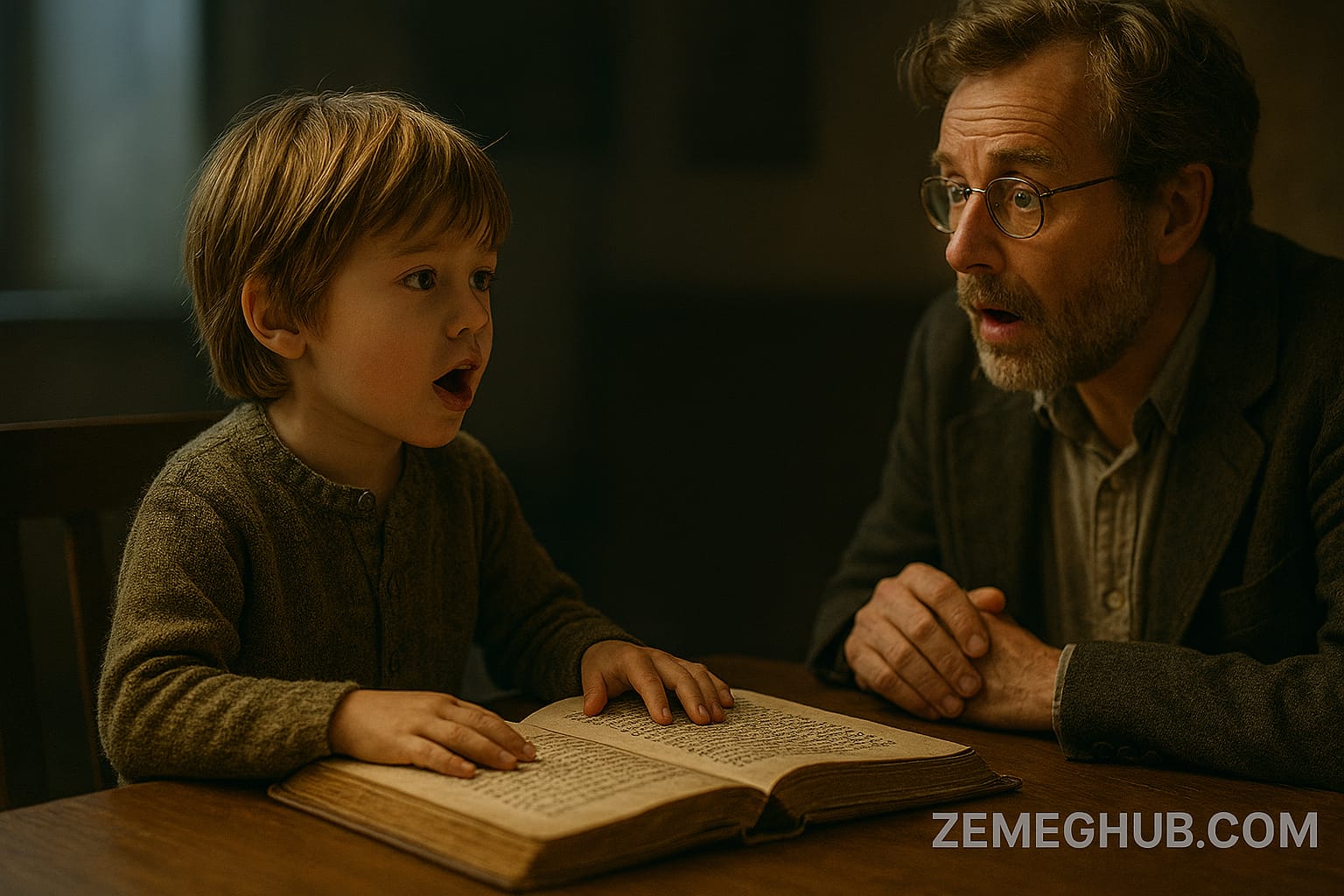
When the story first appeared on a small Norwegian community forum, it seemed destined to disappear into the endless noise of the internet. A curious anecdote, a strange coincidence, perhaps even a misunderstanding. But it didn’t disappear. It spread — quietly at first, then rapidly — because every new detail made the story harder to dismiss. Every witness confirmed the same impossible truth: a six‑year‑old boy from a remote village in Norway had begun speaking a language no one around him had ever heard.
It began on a cold January morning. Snow pressed against the windows of the family’s wooden house, and the boy’s mother was preparing breakfast when she heard him whispering to himself. At first she assumed he was playing, inventing sounds the way children often do. But something about the cadence made her pause. The words had structure. Rhythm. Intention. She leaned closer, expecting to hear fragments of English from cartoons or maybe a song he had picked up at school. Instead, she heard a stream of unfamiliar syllables — sharp, melodic, ancient.
That night, she recorded him on her phone. The next day, unsure of what she had captured, she sent the video to a friend who taught linguistics at the University of Oslo. Within hours, the friend called back, breathless.
“Do you understand what he’s saying?”
“No,” she replied.
“He’s speaking Old Norse. Perfectly.”
Old Norse — the language of the Vikings — had vanished a millennium ago. Today, only scholars and historians can read fragments of it, and even they debate pronunciation. Yet here was a child, barely old enough to tie his shoes, speaking it with fluency.
The family had no connection to Viking studies. No books, no documentaries, no relatives who studied ancient languages. They lived far from museums or universities. The boy had never even seen runes.
As the story spread, researchers traveled to the village to meet him. They expected confusion, shyness, maybe a child overwhelmed by attention. Instead, they found a calm, soft‑spoken boy who answered their questions in Old Norse as if it were the most natural thing in the world. When they asked him where he learned the language, he shrugged and said, “I didn’t learn it. I just remembered it.”
The phrase sent chills through the room.
Over the following weeks, the boy was tested by linguists, neurologists, psychologists, and historians. They showed him ancient runic inscriptions. He read them aloud effortlessly. They asked him to describe objects using Old Norse vocabulary. He did — with terms so obscure that even experts had to check reference texts. His grammar was precise. His pronunciation matched reconstructions made by scholars. He even used idiomatic expressions found only in medieval manuscripts.
No one could explain it.
Some researchers suggested cryptomnesia — the brain retrieving forgotten fragments of something once heard. But the boy had never been exposed to Old Norse. Not even accidentally. Others proposed genetic memory, a controversial idea explored in stories like A Woman Hit by Stroke, Awakened as Painter, where hidden abilities emerge unexpectedly after neurological shifts. But the boy had no history of trauma, no unusual brain activity, no medical events that could explain such a phenomenon.
The most astonishing moment came during a session in which researchers played recordings of reconstructed Old Norse chants. The boy listened quietly, then corrected the pronunciation — confidently, gently, as if he were reminding them of something obvious. The room fell silent.
For months, the phenomenon continued. The boy spoke Old Norse at random moments — while playing with toys, while walking through the snow, while drifting to sleep. His parents described it as “like watching him step into another world.”
And then, just as suddenly as it began, it stopped.
One morning, he woke up and could no longer recall a single word. When researchers asked him to repeat phrases he had once spoken effortlessly, he looked confused. “I don’t know that language,” he said.
The recordings remain. The transcripts remain. The stunned expressions of the linguists who witnessed it remain. But the ability itself vanished, as if it had been borrowed from another time and then returned.
Some call it a neurological anomaly.
Some call it a mystery.
Some call it a reminder that the human mind still holds secrets we are far from understanding.
Whatever the explanation, one thing is certain:
for a brief moment, a forgotten language lived again — spoken not by a scholar, but by a child who had never heard it before.