

How do billionaires legally pay little to no taxes?
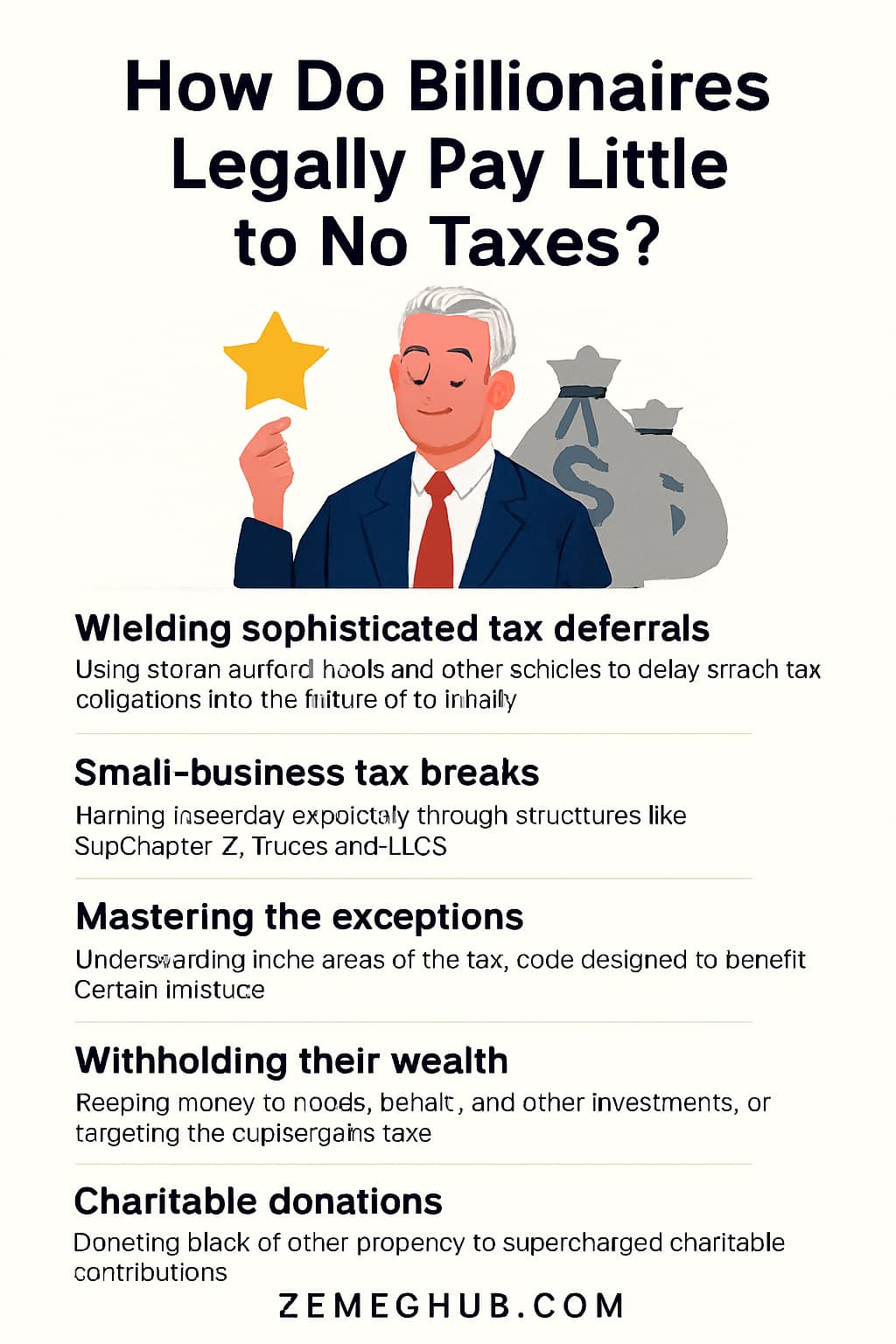
Billionaires legally pay little to no taxes by leveraging a tax system that favors wealth over income—using strategies like borrowing against assets, deferring income, and exploiting loopholes that most people never encounter.
Let’s step into the quiet corridors of extreme wealth, where the rules of money operate on a different plane. In this world, billionaires don’t just earn—they accumulate. Their wealth grows not through salaries or wages, but through stocks, real estate, and business ownership. And here’s the twist: none of that growth is taxed until it’s sold. This is the foundation of how the ultra-rich can legally pay little—or sometimes nothing—in income taxes.
Take a moment to picture a billionaire’s financial life. They own billions in stock, but they don’t sell it. Instead, they borrow against it. A bank sees their portfolio and offers a low-interest loan. The billionaire takes that loan and uses it to buy homes, yachts, fund ventures, or simply live. Because loans aren’t income, they’re not taxed. It’s a strategy known as “Buy, Borrow, Die.”
Here’s how it works:
-
Buy assets that appreciate—stocks, companies, property.
-
Borrow against those assets to access cash without triggering taxes.
-
Die, and pass the assets to heirs. Thanks to a rule called the “step-up in basis,” the heirs inherit the assets at current market value, erasing the capital gains tax that would’ve been owed.
Meanwhile, the billionaire’s official income—what the IRS sees—is often shockingly low. They might report a few hundred thousand dollars, even while their net worth grows by billions. That’s because unrealized gains—the increase in value of assets not yet sold—aren’t taxed under current U.S. law.
They also use tax deductions and credits to reduce taxable income. Charitable donations, investment losses, depreciation on property—all of these can shrink their tax bill. Some billionaires even fund their own foundations, donating appreciated stock, getting a tax deduction, and retaining influence over how the money is used.
Then there are offshore accounts and tax havens. While not all billionaires use them, some park assets in countries with low or no taxes, shielding wealth from domestic tax authorities. These structures are legal, though controversial, and often hidden behind layers of shell companies and trusts.
And let’s not forget capital gains tax rates, which are lower than income tax rates. If a billionaire does sell stock, they pay far less than someone earning the same amount through wages. This is why someone working two jobs might pay a higher effective tax rate than someone with a private jet.
All of this is legal. It’s not tax evasion—it’s tax avoidance, a game played with elite accountants, lawyers, and financial advisors. The system itself allows it. The tax code is riddled with incentives for investment, business ownership, and wealth preservation. It’s not designed to tax wealth—it’s designed to tax income.
So when you hear that a billionaire paid zero in federal income tax, it’s not a glitch. It’s the result of a system that treats wealth as sacred and income as taxable. It’s a quiet strategy, played behind closed doors, with rules most people never learn.
And unless those rules change, the game continues.