

Entangled Souls: What Quantum Physics Reveals About Human Connection
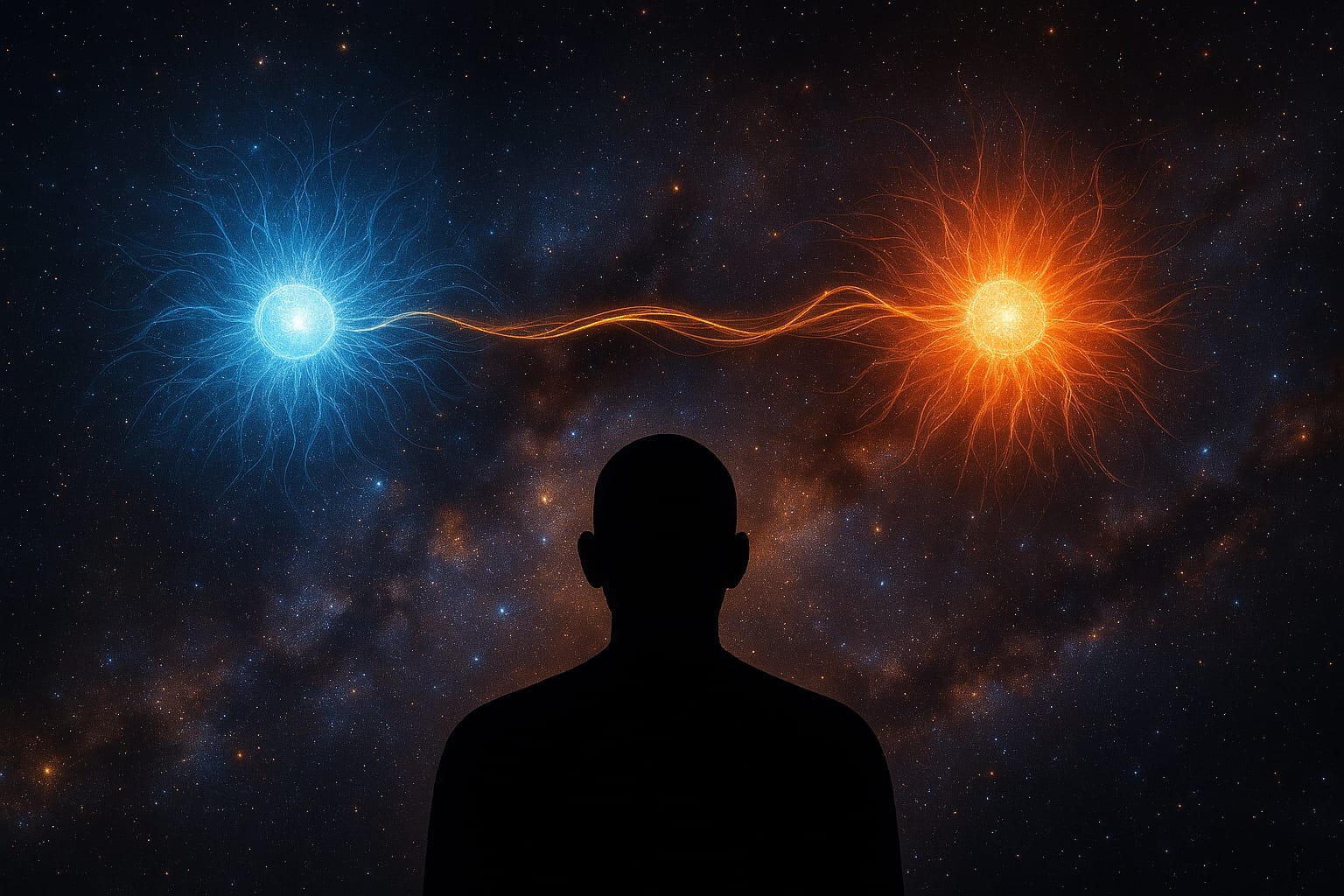
There are forces in the universe so subtle, so profound, they defy our senses. We cannot see them, cannot touch them, and yet they shape everything—from the spin of particles to the ache in our hearts when someone we love is far away.
One of these forces is quantum entanglement.
In the realm of quantum physics, entanglement describes a phenomenon where two particles become linked in such a way that their states remain connected, no matter how far apart they travel. Change one, and the other responds instantly—even if separated by galaxies. Einstein called it “spooky action at a distance.” But perhaps it’s not spooky at all. Perhaps it’s the most intimate truth the universe has ever whispered.
A Cosmic Mirror of Human Emotion
Imagine two people meeting for the first time. There’s a spark—not just emotional, but energetic. Something shifts. Something binds. And even when life pulls them apart—across cities, across years—the connection remains. They think of each other at the same moment. They feel each other’s joy, their pain, their longing. Science might call it coincidence. But entanglement offers another possibility: that we are, quite literally, woven into each other’s quantum fabric.
This isn’t just poetic metaphor. Experiments have shown that entangled particles react to each other faster than light could travel between them. It’s as if space and time collapse in the presence of connection. And if particles can do this… why not people?
The Science Behind the Mystery
Entanglement begins when two particles interact in a way that links their quantum states. Once entangled, they behave as a single system, even when separated. This has been proven in labs using photons, electrons, and even atoms. It’s the foundation of quantum computing, quantum encryption, and the future of secure communication.
But what’s most astonishing is that entanglement defies classical logic. It suggests that reality is not local—that what happens “here” can instantly affect what happens “there.” It challenges our understanding of causality, of distance, of individuality.
And it opens the door to something more: a universe where connection is not the exception, but the rule.
Entanglement as a Spiritual Metaphor
Across cultures and centuries, mystics have spoken of invisible threads that bind us. The Vedic concept of Rta, the Taoist flow of Qi, the Christian idea of divine unity—all echo the same truth: that we are not separate. That love, empathy, and intuition are not just emotions, but energies.
Quantum entanglement gives scientific language to these ancient intuitions. It suggests that when we bond deeply with someone, we may leave an imprint—not just in memory, but in the very structure of reality. That our souls, like particles, can become entangled.
Have you ever felt someone’s presence before they arrived? Dreamed of someone and discovered they were thinking of you? These moments, often dismissed as coincidence, may be glimpses into a deeper order—one where consciousness itself is entangled.
The Future of Connection
As quantum research advances, we may discover that entanglement isn’t limited to particles. Some physicists speculate that the brain’s neurons may exhibit quantum behavior. That consciousness could be a quantum field. That love, memory, and intuition might be entangled phenomena.
If this is true, then every relationship we form—every moment of vulnerability, every act of compassion—creates ripples that transcend space and time. We become part of each other’s quantum story.
And perhaps, when we die, those entangled threads remain. Perhaps love is not lost, but transformed—echoing in the quantum field, waiting to be felt again.
We Are the Universe Remembering Itself
Entanglement reminds us that we are not isolated beings drifting through space. We are part of a vast, interconnected web—of particles, of emotions, of stories. The universe is not a cold machine, but a living tapestry. And every time we love, every time we remember, every time we reach out—we weave ourselves deeper into its fabric.