
Voyager 1 Crosses Fiery Cosmic Boundary: NASA Confirms Historic Discovery
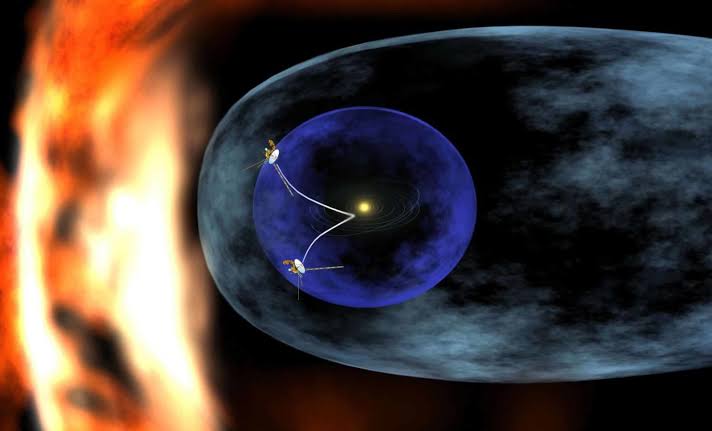
In a stunning milestone for space exploration, NASA has confirmed that Voyager 1 has crossed the heliopause—the invisible boundary marking the edge of our solar system—and entered interstellar space. But what’s truly remarkable is the spacecraft’s passage through a mysterious zone now dubbed the “wall of fire.”
What Is the Heliopause?
The heliopause is where the solar wind from our Sun meets the pressure of the interstellar medium. It’s not a visible wall, but a dynamic frontier where solar influence fades and galactic forces begin. Voyager 1, launched in 1977, has now traveled nearly 24 billion kilometers to reach this threshold.
The “Wall of Fire”: A Misleading Name?
NASA scientists report that this region reaches temperatures of up to 30,000°C. However, the term “wall of fire” is misleading. These extreme temperatures refer to the kinetic energy of fast-moving particles—not heat as we experience it. Space is so sparse that these particles rarely collide, meaning Voyager 1 remains unharmed, gliding through what feels more like a warm cosmic breeze than a furnace.
Magnetic Surprises Beyond the Solar System
One of the most unexpected findings is the similarity between magnetic fields inside and outside the heliopause. Scientists had predicted a stark contrast, but Voyager 1 revealed that solar magnetic field lines stretch far beyond the planets, interacting with galactic forces in ways that challenge previous models. This magnetic reconnection helps explain the heat and energy observed in the “wall of fire.”
A Testament to Engineering Longevity
Voyager 1 continues to operate with less than 4 watts of power per instrument—less than a nightlight. Its nuclear batteries are fading, yet NASA engineers are keeping key detectors alive. Communicating with the spacecraft takes over 20 hours per signal, using massive antennas to catch its faint transmissions.
Now officially in interstellar space, Voyager 1 will focus on measuring the density, temperature, and magnetic properties of the galactic medium. These readings will inform future missions, possibly paving the way for human exploration beyond Pluto.
Voyager 1’s journey is more than a technical achievement—it’s a symbolic leap into the unknown. Its passage through the heliopause marks humanity’s first steps beyond the solar system, offering insights that could reshape our understanding of space, magnetism, and cosmic boundaries.