
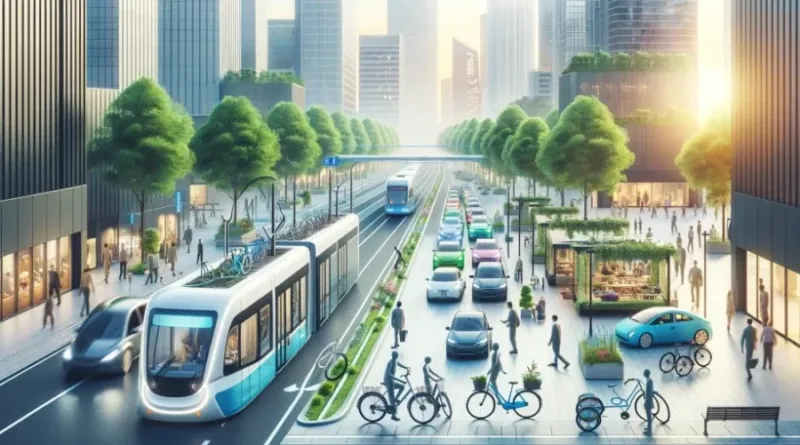
Urban Mobility in 2035: How Cities Will Move, Flow, and Breathe
Urban mobility in 2035 emerges as a living, intelligent ecosystem where cities move, adapt, and breathe in harmony with the people who inhabit them.
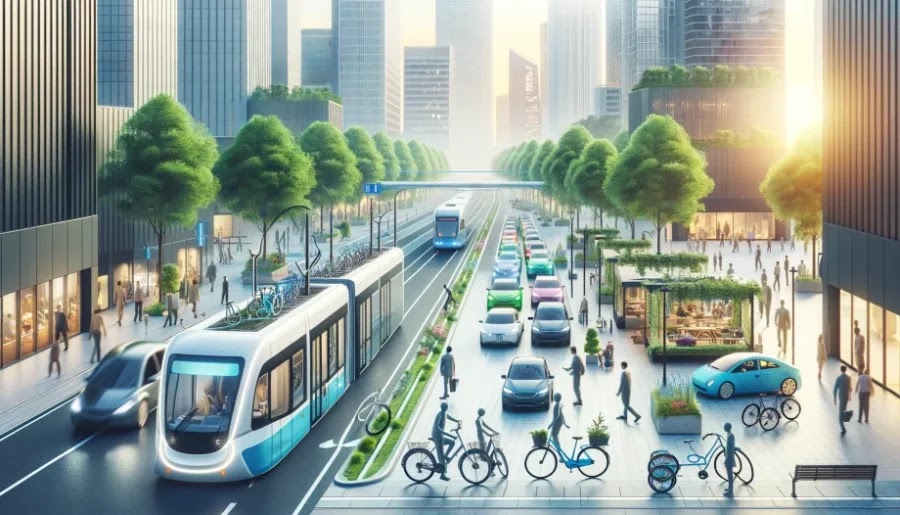
There is a quiet shift happening in the heart of every city. Not the kind marked by construction cranes or new highways, but a deeper transformation—one that rewrites the very rhythm of urban life. Mobility is no longer just a matter of roads and vehicles. It is becoming an ecosystem, a living network of movement shaped by intelligence, sustainability, and the subtle choreography of millions of daily journeys.
To imagine urban mobility in 2035, you must first imagine a city that listens. A city that senses the pulse of its streets, the density of its crowds, the flow of its vehicles. A city that adjusts itself in real time, opening pathways where movement slows, redirecting traffic where congestion forms, and creating breathing spaces where people gather. Mobility becomes a conversation between humans and infrastructure, a dialogue carried through sensors, data streams, and invisible networks of intelligence.
In this future, the streets feel different. The noise of combustion engines has faded into memory, replaced by the soft hum of electric motors and the whisper of bicycles gliding through dedicated lanes. Public transit is no longer a rigid schedule but a fluid system that adapts to demand. Buses arrive when needed, not when timetables dictate. Trains synchronize with the flow of the city, adjusting frequency as crowds rise and fall. Movement becomes responsive, almost intuitive.
Autonomous vehicles weave quietly through this landscape, not as isolated machines but as participants in a larger choreography. They communicate with one another, coordinating their paths with mathematical precision. They anticipate the hesitation of a pedestrian, the sudden turn of a cyclist, the shifting patterns of traffic. Their intelligence is not separate from the city—it is part of it. As explored in “https://www.zemeghub.com/2026/02/what-is-autonomous-driving-narrative.html“the evolution of autonomous driving, vehicles are learning to navigate the world with a calmness and clarity that reshapes the very idea of movement.
But the transformation of mobility is not only technological. It is deeply human. Cities in 2035 are designed around people rather than cars. Sidewalks widen. Green corridors stretch between neighborhoods. Public spaces become sanctuaries where movement slows and life unfolds. The distance between home, work, and community shrinks—not because the city becomes smaller, but because mobility becomes smarter.
Micromobility flourishes in this environment. Electric scooters, compact e‑bikes, and lightweight personal vehicles form a new layer of urban movement—fast enough to be efficient, small enough to be gentle. They fill the spaces between public transit and walking, creating a seamless continuum of mobility where every journey feels natural and connected.
Energy, too, becomes part of the story. Charging stations blend into the architecture of the city. Solar canopies power fleets of shared vehicles. Buildings store and release energy as mobility demands rise and fall. The boundary between transportation and infrastructure dissolves, creating a city that breathes in harmony with its movement.
Yet the most profound change is the shift in how we experience the city. Mobility in 2035 is not about speed—it is about fluidity. It is about reducing friction, eliminating stress, and creating a sense of ease in the way we move. Journeys become moments of reflection rather than tension. Streets become places of connection rather than conflict. The city becomes not just a space we inhabit, but a companion that moves with us.
Urban mobility in 2035 is not a distant dream. It is the natural evolution of the technologies and ideas already reshaping our world. It is the quiet merging of intelligence, sustainability, and human-centered design. It is the promise of a city that moves gracefully, breathes deeply, and adapts to the rhythms of the people who call it home.
And as this future unfolds, we find ourselves stepping into a new relationship with the places we live. Movement becomes effortless. Cities become alive. And mobility becomes not just a necessity, but a form of harmony.