
The Silence Inside the Canvas: Why Minimalist Art Speaks in Empty Spaces
A meditation on how minimalist art uses silence and empty space to invite deeper emotion, presence, and personal meaning.
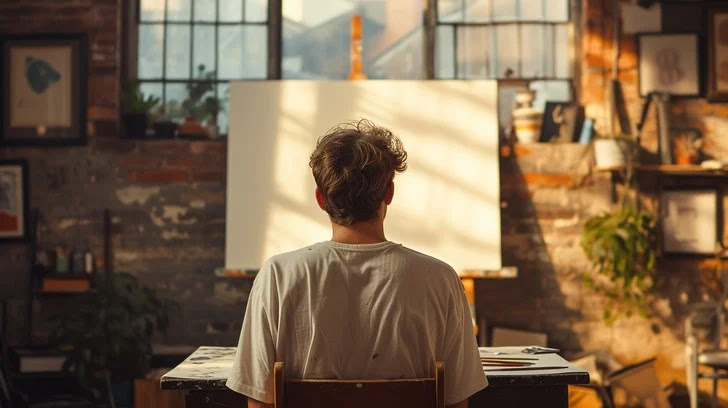
There is a moment, standing before a nearly empty canvas, when the mind expects something to happen — a burst of color, a narrative, a gesture that explains itself. Instead, there is space. A pause. A silence so deliberate it feels like an invitation. Minimalist art lives in that moment. It speaks not through what is present, but through what has been intentionally left out.
In a world saturated with images, noise, and constant stimulation, minimalism feels almost radical. It asks us to slow down. To breathe. To notice the subtle shifts of light, the quiet tension between two shapes, the weight of a single line. It is an art form built on reduction, but what remains is not emptiness — it is concentration. Essence. A distilled form of emotion that doesn’t overwhelm but resonates.
The power of absence is strange. A crowded canvas tells you what to feel; a sparse one asks you to participate. It leaves room for your own inner landscape to surface. The viewer becomes part of the artwork, completing it with memory, mood, and imagination. Minimalism doesn’t impose meaning — it creates a space where meaning can unfold.
This is why silence becomes a form of expression. The blankness is not void but presence. A presence that holds tension, vulnerability, and clarity. It takes courage for an artist to stop before the canvas feels “full,” to trust that a single gesture can carry the weight of an entire emotional world. It takes equal courage for the viewer to stand in front of that simplicity without rushing to fill it with explanation.
Minimalist art is not about lack. It is about attention. It teaches us to listen to what is usually ignored — the quiet edges, the negative space, the breath between forms. It reminds us that beauty does not always need to be loud, that emotion does not always need to be dramatic, that meaning can emerge from stillness.
In this way, minimalism mirrors something deeply human. We spend so much of our lives surrounded by noise — external and internal — that the rare moments of silence feel almost sacred. Minimalist art captures that sensation. It becomes a refuge, a pause, a clearing in the forest of visual clutter.
And perhaps that is why these nearly empty canvases hold so much emotion. They give us back to ourselves. They allow us to see not just the artwork, but the space within us that responds to it.
Minimalism is not the absence of expression.
It is expression stripped to its purest form.
A quiet conversation between the canvas and the soul.