
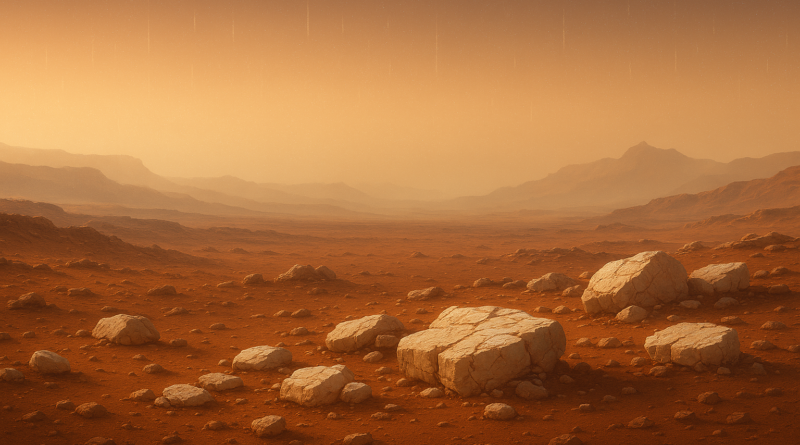
The Memory of Rain: How Ancient Martian Rocks Reveal a Lost Climate
New Martian rock samples reveal chemical traces of ancient rainfall, reshaping our understanding of the planet’s lost climate.
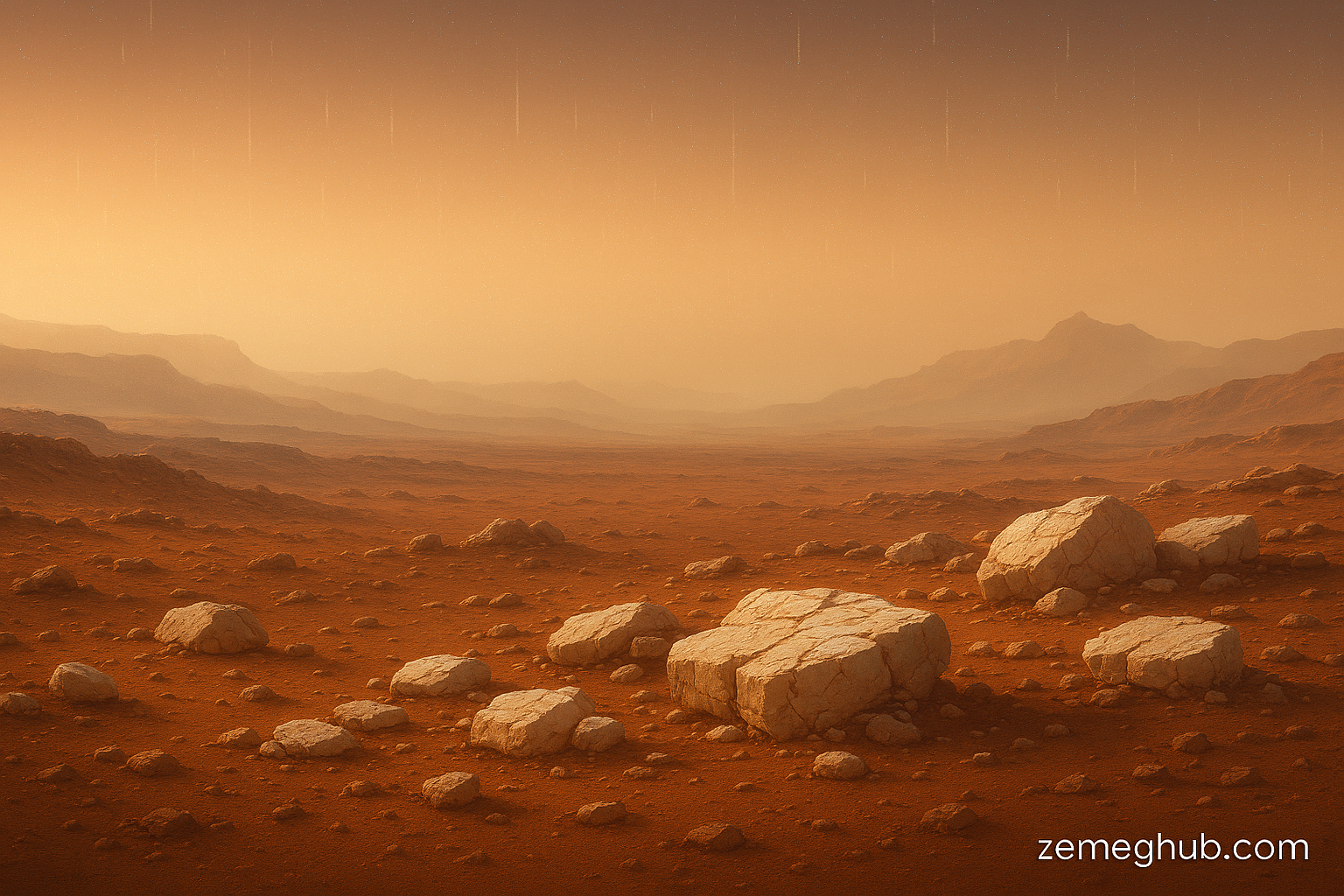
For decades, Mars has been portrayed as a barren world — a place of dust storms, frozen plains, and silence. But in early 2026, a new discovery has begun to rewrite that image. A cluster of strange white rocks, found by the Perseverance rover in the Jezero Crater, has revealed chemical signatures that point to something astonishing: millions of years of rainfall. Not just isolated storms, but a sustained hydrological cycle that may have shaped the Martian surface in ways we never imagined.
The rocks themselves are unlike anything previously catalogued. Their pale coloration, unusual porosity, and layered mineral composition suggest a long history of interaction with liquid water. Scientists analyzing the samples found traces of hydrated silicates and sulfates — minerals that typically form in the presence of standing water and repeated wet‑dry cycles. More intriguingly, the isotopic ratios within the rocks indicate that the water wasn’t just underground or trapped in ice. It fell from the sky.
This revelation challenges decades of assumptions about Mars. If rain once fell regularly on the planet, then its atmosphere must have been thicker, warmer, and more Earth‑like than previously believed. It also raises questions about the possibility of life. Rain creates surface lakes, rivers, and deltas — environments where microbial life could thrive. And if such conditions persisted for millions of years, the window for habitability expands dramatically.
The discovery also echoes themes explored in The Ocean’s Twilight Zone: A Hidden Ecosystem That Could Rewrite Marine Biology where scientists uncovered life in places once thought inhospitable. In both cases, nature reveals its secrets not through dramatic events, but through quiet persistence — the slow accumulation of clues hidden in stone, sediment, and silence.
What makes this Martian rain story so compelling is its subtlety. There are no fossilized trees, no ancient fish, no dramatic ruins. Just rocks — silent, white, and weathered. Yet within them lies a memory of climate, a record of time, and perhaps a whisper of life. It is a reminder that discovery often begins not with answers, but with the courage to ask different questions.
As researchers continue to analyze the samples and refine their models, one thing becomes clear: Mars is not finished surprising us. And in the quiet chemistry of its rocks, we may find not only the story of a lost climate, but the beginning of a new chapter in planetary science.
source: NASA Jet Propulsion Laboratory — Perseverance Rover Findings on Hydrated Minerals in Jezero Crater