
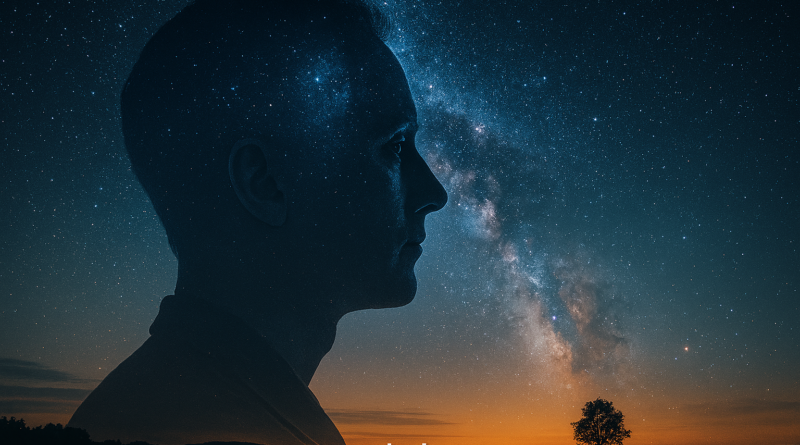
Biocentrism: When the Universe Notices Us
When consciousness awakens, the universe begins — a cosmic dawn shaped by perception.

There is a moment, just before you open your eyes in the morning, when the world hasn’t fully returned yet. It hangs there, suspended, as if waiting for your signal to start moving again. Then you inhale, shift your body, and reality recomposes itself: light filters through the window, the distant hum of a car crosses the street, time resumes its flow. It’s a fragile instant, almost imperceptible, yet it contains an intuition that traditional science has always avoided: what if it’s your consciousness that brings all of this back to life?
Biocentrism is born from this very question. Not as a provocation, but as a radical reversal of perspective. Robert Lanza, physician and researcher, dared to place life — and above all, consciousness — at the center of the universe. No longer an evolutionary accessory, no longer a side effect of matter, but the very matrix from which matter takes shape.
According to this view, the universe is not a static stage that hosts us: it is a dynamic process that activates only when someone observes it. Time does not flow on its own, space does not exist on its own, reality is not an independent block detached from us. Everything we perceive is intertwined with our presence, as if the universe needed a gaze to become real.
It’s an idea that can be unsettling. We grew up believing that consciousness is a product of the brain, an emergent phenomenon born from billions of neurons firing in patterns. But biocentrism flips the script: consciousness does not arise from matter — matter exists because consciousness is there. Without an observer, Lanza argues, there is nothing to observe.
This theory does not aim to rewrite physics, but to complete it. Quantum mechanics, with its paradoxes and peculiarities, has been hinting for decades that observation changes what is observed. Biocentrism pushes this intuition to its extreme: if the observer is indispensable, then consciousness is not a detail — it is the foundation.
A similar idea emerges in Panpsychism: Is Consciousness Woven Into the Fabric of Reality? , where consciousness is explored not as a byproduct of matter, but as a fundamental feature of the universe itself.
And what does it mean, then, to be alive? Not mere organisms drifting through an indifferent universe, but centers of perception that help construct it. Every living being becomes a unique point of view, a fragment of consciousness participating in the creation of the world. Life is not a cosmic accident; it is the engine of the cosmos itself.
The implications are dizzying. If time is a mental construction, what do “before” and “after” really mean? If space depends on perception, how real is the distance that separates us from others? And above all: if consciousness is the foundation of the universe, what happens when the body dies? Biocentrism does not offer definitive answers, but it opens doors that traditional science hesitates to approach.
Perhaps, more than a theory, it is an invitation. To see the world not as something external, but as a continuous dialogue between us and what we perceive. To recognize that reality is not a monolith, but a living, fluid process that renews itself every time we cross it with our attention.
So the next time you wake up and feel the world reassembling around you, try to catch that suspended moment. Maybe it’s not the universe welcoming you back. Maybe it’s you bringing it into existence.