

China’s Investment Crash Raises Major Credit Risks for Banks and Homebuilders
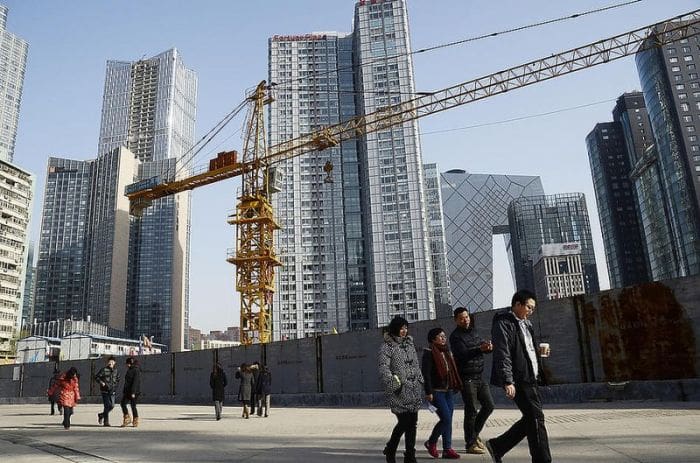
China is entering one of the most delicate phases of its modern financial history. What began as a slowdown has now hardened into a structural contraction, and the consequences are rippling far beyond the property market. The country has posted its first annual decline in fixed‑asset investment in decades, a drop of 3.8% in 2025, falling to 48.52 trillion yuan — a symbolic break in the engine that powered China’s rise for forty years.
The downturn is not a simple cyclical dip. It is a deepening fracture running through the pillars of China’s economy: homebuilders, banks, construction firms, and even local governments. Fitch Ratings warns that the investment slump in the second half of 2025 has created significant cross‑sector credit risks, pushing already‑strained developers closer to distress and tightening the financial pressure on lenders.
The property sector — once the gravitational center of Chinese growth — is now the epicenter of the crisis. Developers who relied on constant land sales, pre‑sales, and easy credit are facing a market where demand has evaporated and financing channels have narrowed. Some are already in distress; others are quietly approaching the edge. The collapse of investment has exposed how dependent the entire system was on perpetual expansion.
Banks, long considered the stabilizing force of China’s financial architecture, are now absorbing the shock. As property developers struggle to service debt, the pressure moves upstream into the balance sheets of lenders. Fitch notes that the combination of a slowing economy and weak domestic demand is eroding borrowers’ ability to repay, creating rising default risks across multiple sectors.
Local governments — heavily reliant on land‑sale revenue — are facing their own reckoning. With land transactions collapsing, their budgets are tightening, and their ability to support infrastructure spending is weakening. This is particularly dangerous because infrastructure investment has long been Beijing’s emergency lever for stabilizing growth. Now, even that lever is losing strength.
The broader picture is one of an economy caught between structural fatigue and the limits of old remedies. The property sector has collapsed 17.2%, according to market analyses, and the ripple effects are spreading into construction, banking, and public finance.
Yet the story is not one of total collapse. Beijing is attempting to counter the downturn by pushing investment into the digital economy and infrastructure modernization. Fitch suggests this may lead to a mild recovery in public investment — but not enough to offset the structural decline in real estate.
For global markets, the implications are immediate. China’s slowdown is shaping investor sentiment worldwide, raising concerns about commodity demand, supply‑chain stability, and the long‑term trajectory of the world’s second‑largest economy. The fear is not just that China is slowing — but that it is entering a new era where the old engines of growth no longer function.
The investment crash is more than a statistic. It is a signal that the model that carried China for decades is straining under its own weight. And as credit risks rise across homebuilders, banks, and governments, the world is watching to see whether Beijing can engineer a soft landing — or whether the slowdown will deepen into something far more disruptive.
Sources
-
CNBC report on China’s investment slump and Fitch’s warning about rising cross‑sector credit risks.
Editorial Disclaimer
This article summarizes publicly available economic data and credit‑risk assessments related to China’s investment downturn. It is intended for informational and editorial purposes only and should not be interpreted as financial advice, investment guidance, or a prediction of future market performance. Economic conditions, credit ratings, and policy responses can change rapidly. Readers should conduct independent research and consult qualified financial professionals before making any investment or strategic decisions.