

Atlantis: The Memory of a World That Refuses to Disappear
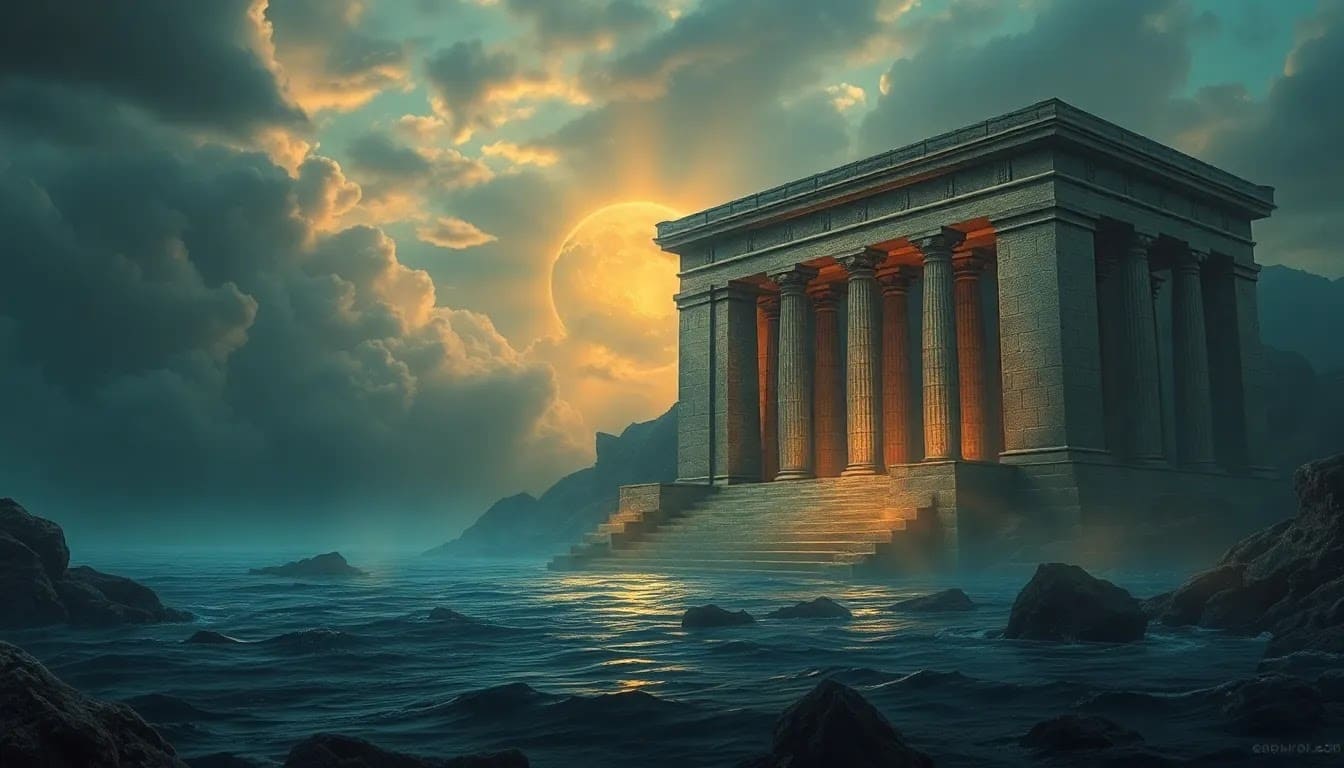
There are stories that refuse to die. Stories that move like tides — retreating, returning, reshaping themselves with every generation. Atlantis is one of them. A name whispered across millennia, rising from the depths of Plato’s dialogues and drifting into archaeology, geology, mysticism, and pop culture. It is a myth, a metaphor, a possibility. And perhaps more than anything, it is a memory — not of a place we can locate on a map, but of something humanity feels it once knew.
The first time Atlantis appears in recorded history is around 360 BCE, in Plato’s Timaeus and Critias. He describes a powerful island civilization beyond the Pillars of Hercules — the ancient name for the Strait of Gibraltar — that fell into moral decay and was swallowed by the sea “in a single day and night of misfortune.” Scholars have debated for centuries whether Plato intended this as allegory or history. But the world did something unexpected: it refused to treat it as fiction.
Atlantis became a gravitational point for our imagination.
Over time, researchers began to search for traces of it in the real world. Some pointed to Santorini (Thera), where a massive volcanic eruption around 1600 BCE destroyed the Minoan civilization — an event so violent it reshaped the Aegean Sea. Archaeologists like Spyridon Marinatos argued that the sudden collapse of a sophisticated maritime culture could have inspired Plato’s tale. The Minoans had advanced architecture, plumbing, art, and trade networks — a society that felt eerily close to the Atlantis Plato described.
Others looked to the Azores, the Canary Islands, or the submerged structures off the coast of Bimini, where divers in the 1960s discovered a strange underwater formation now known as the “Bimini Road.” Geologists say it is natural limestone. Believers say it is a remnant of a lost city. The debate itself has become part of the myth.
In the Sahara, satellite imagery revealed the Richat Structure, a massive circular formation in Mauritania. Some researchers — including geologist Robert Schoch — have noted its resemblance to Plato’s concentric description of Atlantis. The structure is natural, but its uncanny geometry keeps the speculation alive.
And then there is the theory that Atlantis was never a place, but a pattern. Civilizations rise, flourish, collapse. Knowledge is gained, lost, rediscovered. The Library of Alexandria burned. The Indus Valley Civilization vanished. The Bronze Age Collapse erased entire cultures in a matter of decades. Atlantis becomes the name we give to the worlds that disappear before we understand them.
But the myth also carries something more intimate — a longing for a civilization that lived in harmony with forces we no longer comprehend. Writers like Ignatius Donnelly in the 19th century imagined Atlantis as the cradle of all ancient cultures. Esoteric thinkers like Helena Blavatsky turned it into a spiritual homeland. Modern storytellers transformed it into a symbol of lost wisdom, advanced energy, forgotten technologies.
Atlantis survives because it adapts.
In the 20th century, oceanographers mapped the seafloor and found no sunken continent — yet the legend persisted. In the 21st century, geneticists traced human migrations, archaeologists uncovered Göbekli Tepe, and climate scientists revealed how rising seas swallowed entire prehistoric coastlines. Suddenly, the idea of lost civilizations didn’t seem so far‑fetched. Not Atlantis as Plato described it, perhaps, but worlds erased by time, by water, by catastrophe.
And so Atlantis becomes a metaphor for everything we fear losing — knowledge, balance, connection with nature — and everything we hope to rediscover. It becomes a mirror. A warning. A dream.
Maybe Atlantis is not behind us, but ahead of us. A reminder that the civilizations we build today will one day become stories told by people who cannot imagine our world. A reminder that what we call myth may be memory, and what we call history may be only the surface of something deeper.
Atlantis endures because it speaks to a truth we feel but cannot articulate:
that humanity has forgotten something essential,
and that somewhere, beneath the waves of time,
a part of our story is still waiting to be found.