

The First Confirmed Runaway Supermassive Black Hole — A Cosmic Giant Set Loose
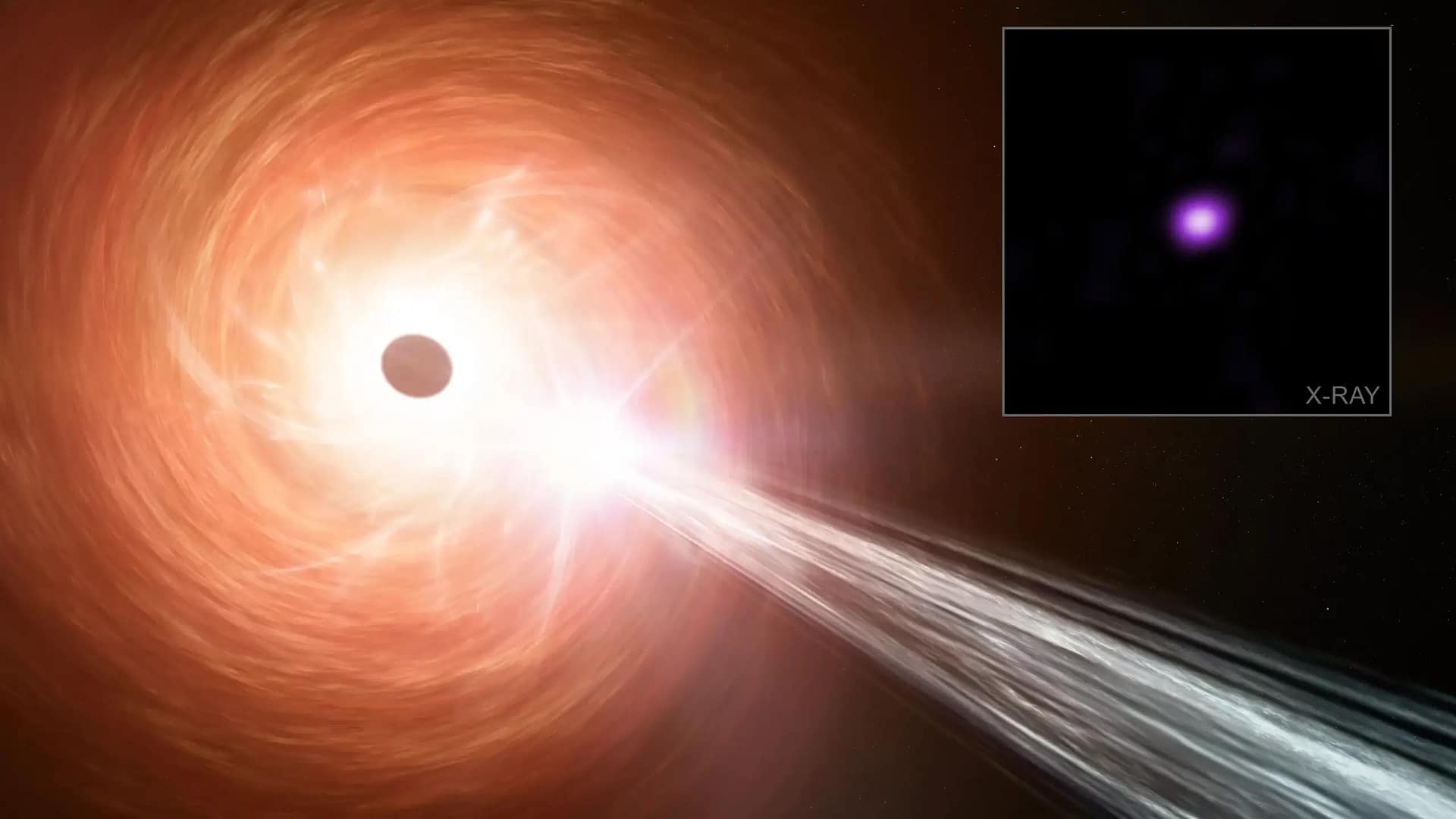
For decades, astronomers whispered about the possibility. Somewhere in the vastness of the universe, a supermassive black hole—one of the most powerful objects known to exist—might one day be found drifting alone, torn from the galaxy that once anchored it. It sounded like myth, a theoretical curiosity, a cosmic rumor waiting for evidence. Now, thanks to the James Webb Space Telescope, that evidence has arrived. The first confirmed runaway supermassive black hole has been found, and it is racing through space with a force that defies imagination.
The discovery began with a trail of light—an impossibly long, narrow streak stretching across intergalactic space. At first glance, it looked like a jet or a filament, but its structure was too clean, too luminous, too strange. JWST’s instruments revealed the truth: the streak was a wake, a glowing scar left behind by a black hole moving so fast that it compresses and ignites the gas in its path. It is a celestial footprint, carved into the darkness by something massive and unstoppable.
This black hole is not a quiet wanderer. It is a titan, millions of times the mass of the Sun, traveling at extraordinary speed. Something in its home galaxy must have gone catastrophically wrong—perhaps a violent gravitational dance between multiple black holes, a cosmic slingshot that hurled one of them outward with enough momentum to escape entirely. Galaxies are usually the cages that hold these monsters in place. To break free is almost unthinkable.
Yet here it is, fleeing across the universe like a rogue star on a scale we have never witnessed. Behind it stretches a trail of newborn stars, ignited by the shock of its passage. It is as if the black hole, often associated with destruction, has become an artist, painting a luminous line of creation across the void. The contrast is almost poetic: a force that devours everything in its grasp leaving behind a river of starlight.
For astronomers, this moment is a revelation. It confirms that galaxies can lose their central engines, that gravitational chaos can eject even the heaviest objects in the cosmos, and that the universe is far more dynamic—and violent—than we imagined. It also raises questions that will echo through astrophysics for years. How many runaway black holes are out there, invisible except for the trails they leave behind? How many galaxies are missing their hearts without us knowing? And what happens to a black hole that spends eternity without a home?
The runaway black hole discovered by JWST is more than a scientific milestone. It is a reminder that the universe is not static but alive with motion, conflict, and transformation. It is a place where even the most massive objects can be thrown into exile, where darkness can carve paths of light, and where the boundaries of the possible are constantly rewritten.
Some discoveries expand our knowledge. Others expand our imagination. This one does both.