

The Journey of Coffee: A Deep Historical Narrative
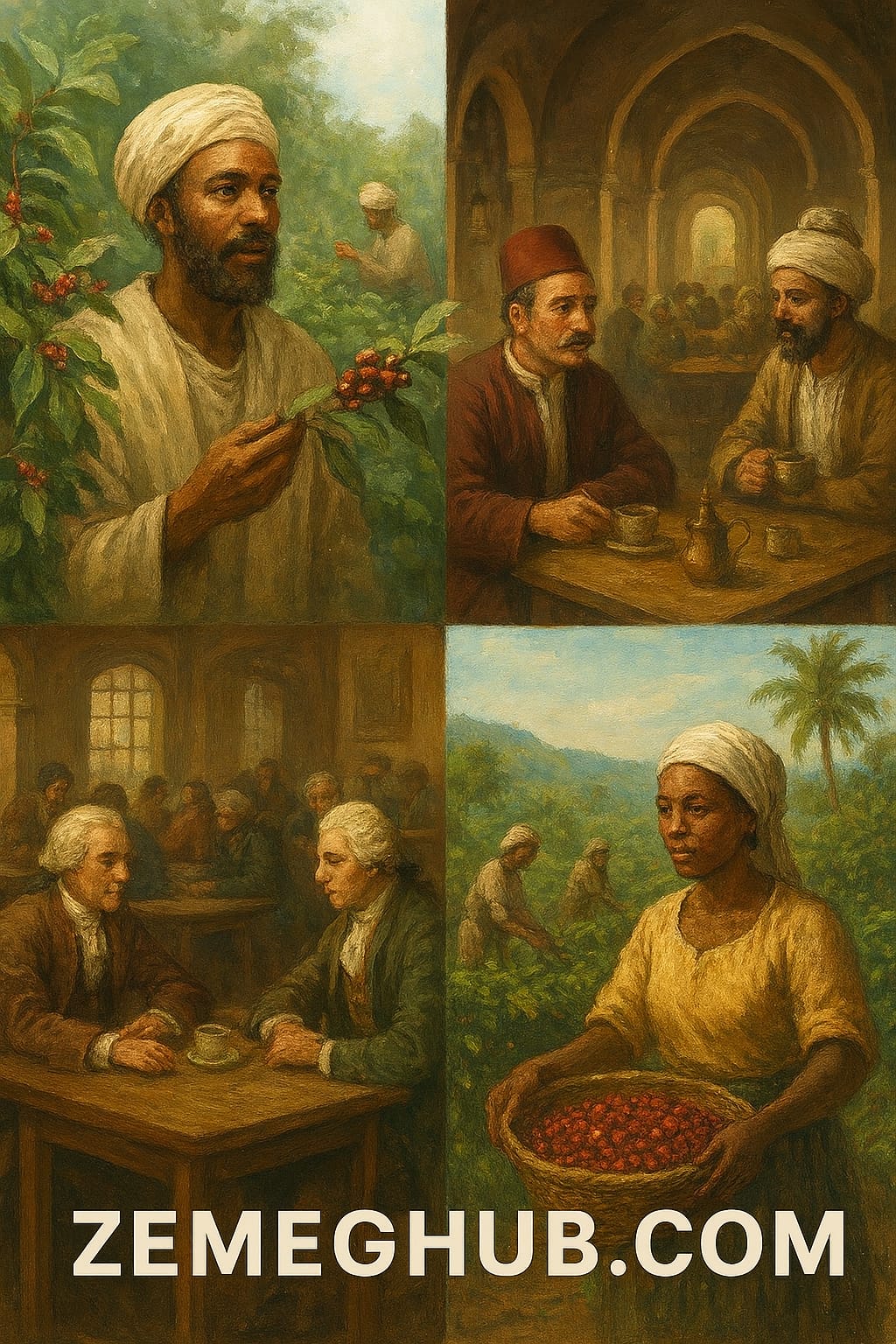
Coffee is not merely a beverage; it is a cultural force that has shaped economies, inspired revolutions, and connected people across continents. Its story is a sweeping saga that begins in the misty highlands of Ethiopia and winds through the bustling ports of Yemen, the intellectual salons of Europe, and the plantations of the New World. To understand coffee is to understand the history of human civilization itself.
Origins in Ethiopia — Myth and Reality
The legend of Kaldi the goat herder is often told as the beginning of coffee’s journey. In the 9th century, Kaldi noticed his goats leaping and dancing after eating the red cherries of a wild shrub. Intrigued, he tried them himself and felt invigorated. Local monks, hearing of this discovery, began crushing the berries and mixing them with water to stay awake during long nights of prayer.
While the tale may be apocryphal, Ethiopia’s highlands are indeed the birthplace of Coffea arabica. For centuries, local tribes consumed coffee not as a drink but as a food — grinding the beans and mixing them with animal fat to form energy-rich balls carried on long journeys. This early use shows coffee’s primal role as sustenance before it became a social ritual.
Coffee and the Islamic World — Devotion and Debate
By the 15th century, coffee had crossed the Red Sea into Yemen, where Sufi mystics embraced it as a spiritual aid. In the city of Mocha, coffee was brewed in simple clay pots and consumed during religious ceremonies. The stimulating drink helped worshippers remain alert during long sessions of chanting and meditation.
From Yemen, coffee spread rapidly through the Islamic world. In Cairo, Mecca, and Istanbul, coffeehouses known as qahveh khaneh became vibrant centers of social life. These establishments were filled with storytellers, musicians, and philosophers. They were places where merchants negotiated deals, poets recited verses, and ordinary citizens debated politics.
Authorities, however, were wary. In Mecca, coffee was banned in 1511 after clerics feared it encouraged radical thought. In Istanbul, Sultan Murad IV outlawed coffee, punishing drinkers severely. Yet the bans never lasted — coffee’s popularity was unstoppable, and it became woven into the fabric of Islamic culture.
Coffee and European Expansion — From Curiosity to Craze
European travelers encountered coffee in the Ottoman Empire during the 16th century. Venetian merchants brought it to Italy, where it was first sold as an exotic medicine. By the early 1600s, coffeehouses appeared in Venice and Rome, attracting scholars and clergy.
In England, coffee arrived around 1650, and by 1700 London boasted over 300 coffeehouses. These were nicknamed “penny universities” because, for the price of a penny, one could buy a cup of coffee and engage in intellectual debate. Coffeehouses became hubs of commerce and culture: Lloyd’s of London, the famous insurance market, began as a coffeehouse where shipowners and merchants gathered to discuss trade.
Not everyone was pleased. In 1674, the Women’s Petition Against Coffee was published in London, claiming that coffee made men impotent and distracted them from their marital duties. King Charles II even tried to suppress coffeehouses, fearing they were hotbeds of sedition. But once again, coffee triumphed, becoming a staple of European life.
Colonialism and Global Spread — Plantations and Power
As demand grew, European powers sought to cultivate coffee themselves. The Dutch smuggled seedlings from Yemen and planted them in Java, giving rise to the term “Java” as a synonym for coffee. The French established plantations in the Caribbean, while the Portuguese expanded cultivation in Brazil.
By the 18th century, Brazil had become the world’s largest producer, a position it still holds today. Coffee’s spread was inseparable from colonialism and slavery. Plantations relied on enslaved labor, and the profits fueled European empires. Coffee thus became both a symbol of cultural exchange and a reminder of exploitation.
The global trade networks built around coffee reshaped economies. Ships carried beans across oceans, merchants speculated on prices, and fortunes were made and lost. Coffee was no longer just a drink — it was a commodity that linked continents in a web of commerce and power.
Coffee and Revolutions — Fuel for Change
Coffeehouses were more than places to drink; they were incubators of revolution. In Paris, cafés became meeting places for Enlightenment thinkers like Voltaire and Rousseau. In London, they hosted debates on science, politics, and philosophy. In Boston, the Green Dragon Tavern — often called a coffeehouse — was where revolutionaries plotted against British rule.
Coffee’s stimulating effects were seen as fuel for rational thought. Unlike alcohol, which dulled the senses, coffee sharpened the mind. This made it the drink of choice for intellectuals and rebels alike. The French Revolution, the American Revolution, and countless smaller uprisings were whispered into motion over cups of coffee.
Modern Coffee Culture — From Commodity to Lifestyle
By the 20th century, coffee had become a global commodity. Brands like Starbucks transformed it into a lifestyle product, selling not just coffee but an experience. Coffeehouses became places of identity, where people worked, socialized, and expressed themselves.
At the same time, artisanal movements revived traditional brewing methods. Turkish cezve pots, Italian espresso machines, and Japanese pour-over techniques gained popularity among enthusiasts. Coffee competitions, specialty roasters, and fair-trade initiatives reshaped the industry, emphasizing quality and ethics.
Today, coffee is both a daily ritual and a cultural phenomenon. It connects farmers in Ethiopia to baristas in New York, linking traditions across centuries. Every sip carries echoes of monks chanting in Yemen, merchants bargaining in Venice, and revolutionaries whispering in Boston taverns.
Coffee’s history is a mirror of human civilization. It is a story of discovery and devotion, of trade and exploitation, of conversation and creativity. To drink coffee is to participate in a tradition that has shaped the world — a tradition that continues to evolve, one cup at a time.