
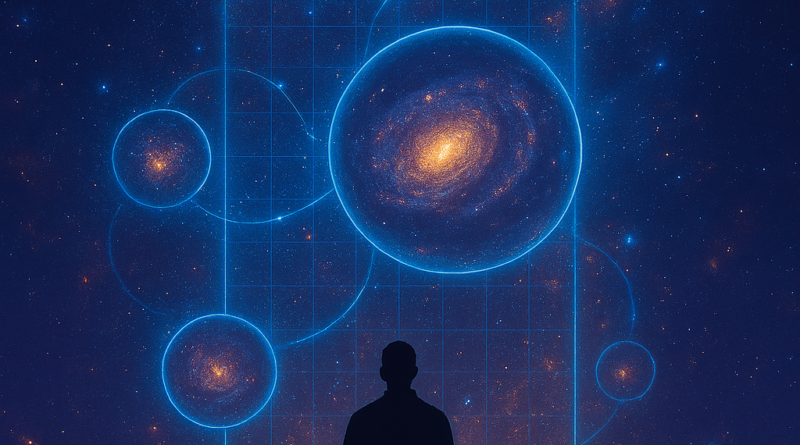
The Holographic Principle: Is Our Universe Just a Cosmic Projection?
By MEDIA CREATION •
Imagine holding a hologram in your hand — a flat, two-dimensional surface that somehow displays a full 3D image. Now imagine that everything you see, touch, and experience in the universe works the same way. That the vast, three-dimensional cosmos we inhabit is actually encoded on a distant, two-dimensional boundary.
This is the mind-bending idea behind the Holographic Principle, a theory that’s not just poetic — it’s grounded in serious physics. It suggests that our universe might be a kind of cosmic illusion, a projection from a deeper, more fundamental reality.
Where the Idea Comes From
The Holographic Principle was born from the study of black holes — those mysterious regions of space where gravity is so intense that not even light can escape. In the 1970s, physicist Jacob Bekenstein proposed that the amount of information (or entropy) inside a black hole wasn’t proportional to its volume, but to the surface area of its event horizon.
This was shocking. It implied that everything inside the black hole — all the matter, energy, and information — could be described by data on its surface. Later, Stephen Hawking added quantum mechanics to the mix, showing that black holes emit radiation and slowly evaporate, raising questions about what happens to the information they contain.
To resolve this paradox, physicists like Gerard ’t Hooft and Leonard Susskind proposed something radical: maybe this surface-based encoding isn’t just true for black holes — maybe it’s true for the entire universe.
What the Holographic Principle Says
In simple terms, the Holographic Principle suggests that all the information in a volume of space can be described by data on its boundary. Just like a hologram stores a 3D image on a 2D surface, our universe might be a 3D projection of information encoded on a distant cosmic horizon.
This idea gained serious traction through the AdS/CFT correspondence, a mathematical framework developed by physicist Juan Maldacena in 1997. It showed that a theory of gravity in a curved space (Anti-de Sitter space) could be equivalent to a quantum field theory on its boundary — a powerful proof-of-concept for holography.
What It Means for Reality
If the Holographic Principle is true, it changes everything:
-
Space and time might not be fundamental. They could emerge from deeper quantum information.
-
The universe could be finite in information. Even infinite space might have a limited “resolution.”
-
Reality might be non-local. Events in one region could be encoded elsewhere, challenging our sense of causality.
This theory also bridges quantum mechanics and gravity, two pillars of physics that have long resisted unification. It offers a glimpse into a deeper layer of reality — one where information, not matter, is the true currency of existence.
Pop Culture Echoes
The Holographic Principle has inspired countless stories and speculations. Films like The Matrix and Inception play with the idea that reality is a construct. Philosophers have compared it to Plato’s Cave, where shadows on a wall are mistaken for truth.
Even simulation theory — the idea that we live in a computer-generated reality — echoes holographic thinking. If the universe is encoded on a boundary, who or what is projecting it?
The Holographic Principle isn’t just a scientific theory — it’s a philosophical revolution. It asks us to reconsider the nature of space, time, and self. It suggests that the universe might be far more abstract — and far more beautiful — than we ever imagined.
And if it’s true, then everything we know is written not in the stars… but on the edge of the cosmos.
Want to go deeper into the illusion?
If the Holographic Principle sparked your curiosity, The Holographic Universe by Michael Talbot will take you further down the rabbit hole. It’s a mind-expanding journey through quantum physics, black holes, and the nature of consciousness — all wrapped in one unforgettable read.
👉 Available now on Amazon in paperback, Kindle, and audiobook formats.
📚 Perfect for Zemeghub readers who crave bold ideas and cosmic mysteries.