
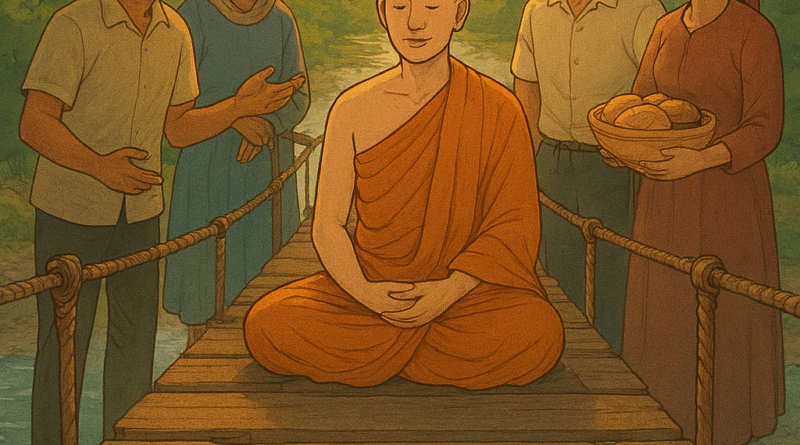
The Bridge of Compassion

At the beginning, the two villages divided by the river lived in constant tension. The rushing water was a source of life, but also of conflict: who could use it to irrigate the fields? Who had the right to cross first on the fragile wooden bridge that connected the two banks? Every day, shouts and arguments filled the air, and that bridge, instead of uniting, had become the symbol of rivalry.
It was then that Tenzin arrived, a Buddhist monk with a serene face and eyes as deep as the winter sky. He carried no wealth or power, only a worn mat and a smile. Each morning he sat in the middle of the bridge, motionless, letting the wind caress his face and the sound of the water become a song. He spoke little, but greeted every traveler with a simple gesture: hands joined and a smile that seemed to soften even the hardest hearts.
“What is that monk doing? Does he think he can stop quarrels with silence?” the skeptics said, shaking their heads as they crossed the bridge. Yet, over time, something subtle happened, almost imperceptible at first.
The farmers, used to rushing across with sacks of grain or baskets of vegetables, found themselves slowing down. It was as if the monk’s calm forced them to breathe more slowly, to set down the weight of their days for a moment. Some stopped beside him, not knowing exactly why, and discovered that his silence was not empty, but welcoming.
One day, two men who had not spoken for years met on the bridge. Instead of turning their backs, they sat for a moment near the monk and, almost without realizing it, began to share the difficulties of their harvests. From that day on, whenever they met, they exchanged at least a greeting.
The women of the village, carrying warm bread or freshly picked fruit, began to offer a piece to the traveler they met. That simple gesture transformed the bridge into a shared table, where food was no longer a cause of dispute but of communion.
Even the children, who once ran shouting and fighting over who should cross first, began to stop and watch the river together. The sound of the water, which once seemed threatening, became a song that united them.
Thus, slowly, the shouts turned into whispers, the suspicions into stories, and the bridge, which for years had been a symbol of division, began to become a place of meeting. It was not the wood that supported it, but the calm the monk had sown, a calm that spread like light among the people.
One summer evening, a child asked Tenzin: “Why do you come here every day?” The monk looked at him and replied softly: “Because compassion is the only bridge strong enough to carry us across the rivers of life.”
As the years passed, the bridge became a sacred place. Pilgrims from afar arrived not for the beauty of the landscape, but to feel the peace that reigned there. It was not the wood that sustained the bridge, but the compassion that Tenzin had planted.
And so, what had begun as a place of conflict was transformed into a sanctuary of peace. The Bridge of Compassion remains today a symbol: when we choose to stop, to listen, and to smile, we can transform places of division into spaces of encounter.