
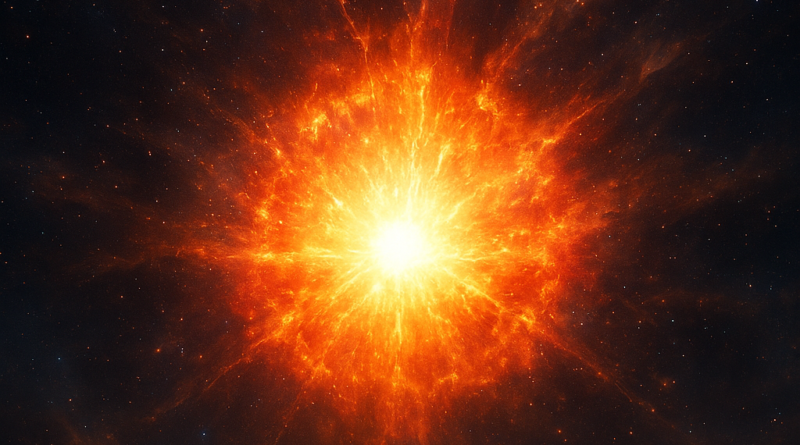
Betelgeuse’s Supernova: Humanity Witnesses the Death and Rebirth of a Star
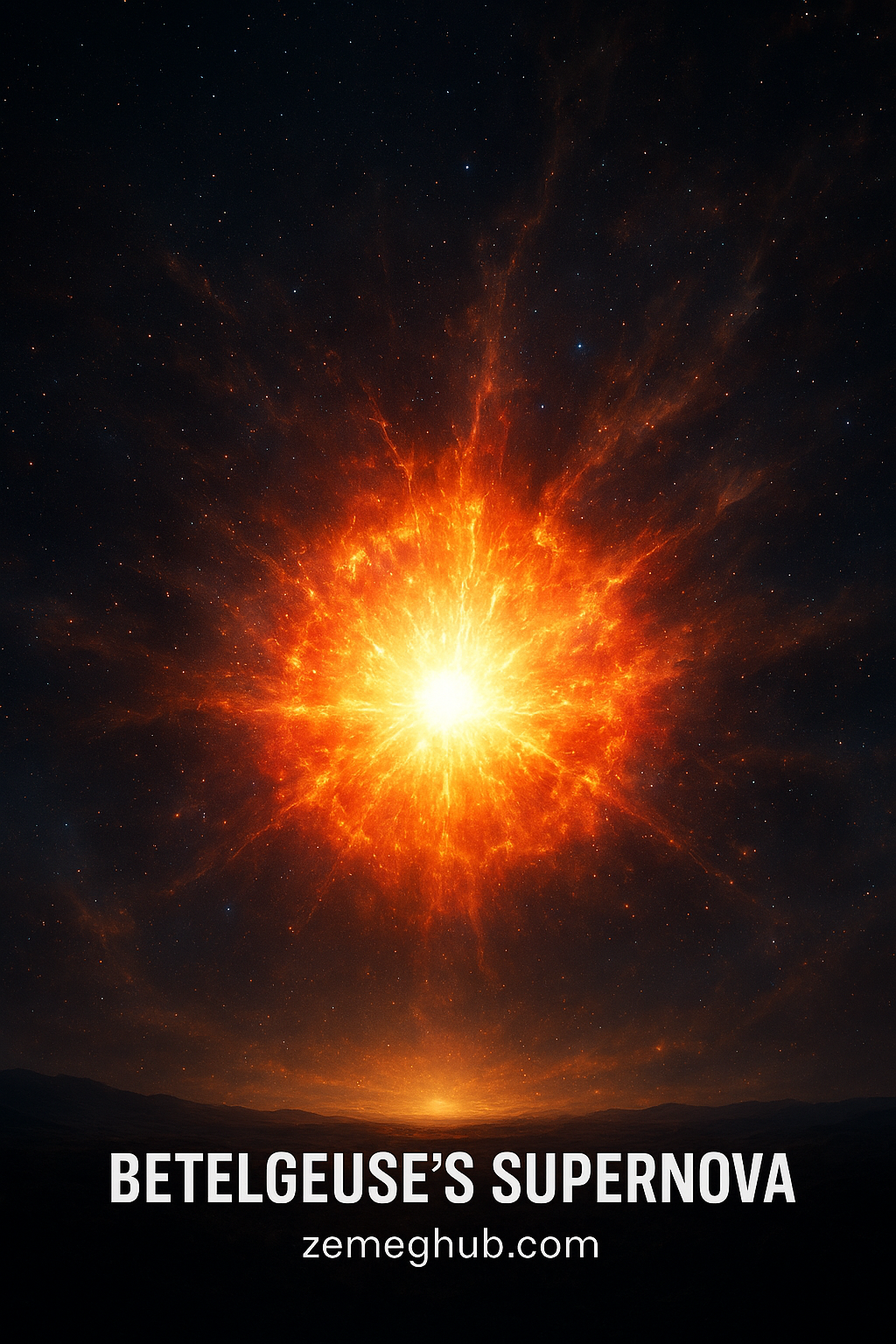
For centuries, the red giant Betelgeuse has burned in the shoulder of Orion like a restless ember — a star so vast and volatile that ancient astronomers already sensed its impermanence. In myth, it was a warrior’s flame. In science, a red supergiant nearing the end of its life.
And in the collective imagination, it has always been a reminder that even the brightest lights eventually fade.
Tonight, we explore the moment astronomers have long contemplated: the hypothetical supernova of Betelgeuse — a cosmic event so powerful it would outshine the full Moon and transform the familiar winter sky into a theater of fire and rebirth.
This is not an ordinary astronomical spectacle.
It is the kind of event that reshapes our understanding of time, matter, and our place in the universe.
A Giant at the Edge of Time
Betelgeuse has always been a star on the brink.
Located roughly 640 light‑years away, it has spent millions of years burning through its fuel at a furious pace. In both modern astrophysics and ancient cosmologies, red supergiants like Betelgeuse are destined to end their lives in spectacular explosions — supernovae that forge the heavy elements essential for planets, oceans, and life.
In this imagined scenario, the star’s core finally gives way to gravity.
In a fraction of a second, Betelgeuse implodes — and then erupts outward in a shockwave of unimaginable force. The explosion floods the sky with light so intense it casts shadows at night and glows even through the daylight haze.
A Sky Rewritten
Across the world, people look upward in awe.
The familiar outline of Orion is transformed, dominated by a new beacon that rivals the brilliance of Venus and challenges the Sun itself. For many, it is a reminder of how small we are in the face of cosmic time. For scientists, it is a once‑in‑millennia opportunity to observe the mechanics of stellar death.
Shockwaves ripple outward, carrying with them the raw materials of creation.
Iron, oxygen, silicon — elements forged in the star’s final moments — scatter into the galaxy. These ashes will drift for ages, eventually seeding new stars, new planets, and perhaps new forms of life.
The Birth Hidden in the Death
A supernova is not an ending.
It is a transformation.
In both modern astrophysics and ancient cosmologies, the death of a star marks the beginning of something new. The remnants of Betelgeuse will one day coalesce into glowing nebulae — clouds of gas and dust that may ignite into new suns.
In this way, Betelgeuse’s legacy becomes eternal, written into the future of the galaxy.
Humanity’s Reflection in the Stars
For humanity, this event is more than science.
It is a reminder of our cosmic ancestry.
Every atom of calcium in our bones, every molecule of iron in our blood, was forged in stars that died long before Earth existed. As Betelgeuse erupts in this imagined scenario, we witness the same process that once made us possible.
It is humbling to realize that the universe recycles itself through fire — and that we are part of that cycle.
🔭 What Science Says Today
While the narrative above imagines Betelgeuse’s future supernova, astronomers emphasize that Betelgeuse has not exploded, nor is there evidence that it will do so anytime soon.
Current scientific understanding shows that:
-
Betelgeuse is a red supergiant nearing the end of its life, but
-
its explosion could occur tomorrow, in 10,000 years, or in 100,000 years
-
the dramatic dimming of 2019–2020 was caused by dust and surface activity, not a collapse
-
when Betelgeuse eventually goes supernova, it will be spectacular but harmless to Earth
The star’s fate is certain — but its timing remains one of astronomy’s great mysteries.
A Night That Becomes Legend
Even as a hypothetical, Betelgeuse’s supernova invites reflection.
Artists will imagine it.
Writers will chase its meaning.
Children will look up and ask why Orion shines differently in stories, and parents will tell them of the star that will one day die so that new worlds might be born.
The universe writes history in light, and humanity is always watching.
This article uses astronomy as a narrative and educational framework, not as a real‑time scientific report or prediction.