

The Door That Wasn’t There Yesterday
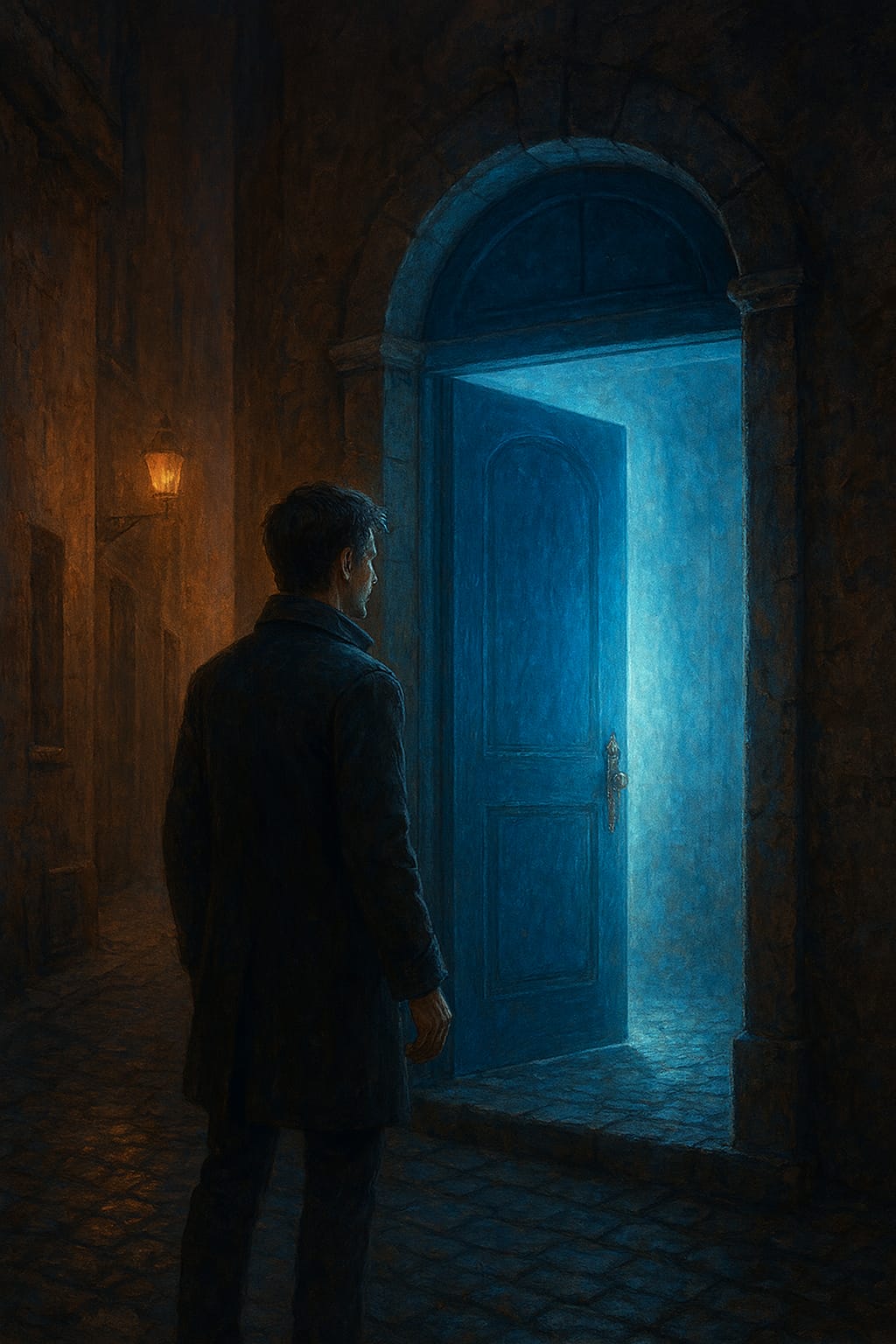
There was a door in the alley behind the café.
It hadn’t been there the day before.
Luca noticed it on his way home, the scent of roasted beans still clinging to his coat. The alley was familiar—he passed it every evening, a shortcut between the cobbled streets of Tolentino’s old quarter and the quiet apartment he called home. But tonight, something was different.
The door was tall, arched, and painted a deep, impossible blue. Not the blue of the sky or the sea, but the blue of dreams you forget upon waking. It had no handle, no hinges, no sign. Just a brass keyhole that shimmered faintly in the streetlight.
He stood there, heart ticking like a metronome, unsure whether to laugh or run.
But curiosity is a stubborn thing.
He reached out.
The door opened.
And the world changed.
A Thousand Lucases
The first thing he noticed was the silence. Not the absence of sound, but the presence of stillness. The kind that hums in your bones.
He stepped through.
The street was the same—but not. The café behind him was now a bookstore. The posters on the wall advertised a concert for a band he’d never heard of: The Velvet Equinox. The air smelled of cinnamon and ozone.
And then he saw himself.
Across the street, another Luca. Same face, same coat—but this one was laughing, arm-in-arm with a woman Luca had never met. She looked at him like he was the sun.
Luca stumbled back, heart pounding. The door behind him was gone.
The Physics of Possibility
Later, when he found a library (which used to be a pharmacy), he read about it. The multiverse. The idea that every decision, every quantum flicker, splits reality into branches. That somewhere, another you lives a life you can only imagine.
He devoured books by Everett, Tegmark, Greene. He learned about quantum decoherence, bubble universes, the string theory landscape. But none of it explained the door. None of it explained the ache in his chest when he saw himself happy.
Because this wasn’t just science. It was personal.
The Weight of What-Ifs
He wandered.
In one world, he was a musician, fingers dancing across piano keys in a smoky jazz bar. In another, a father of three, reading bedtime stories in a language he didn’t recognize. In one, he was gone—his name etched into a stone, flowers wilting at its base.
Each world was a mirror. Each version of himself a reflection warped by choice, chance, or chaos.
He began to wonder: which one was the real him?
But the multiverse doesn’t answer questions. It only asks more.
The Universe That Chose You
Eventually, he found the door again.
It was in a different alley this time, behind a bakery that smelled like his grandmother’s kitchen. He hesitated. He thought of the Luca with the laughing woman. The Luca who never left music school. The Luca who never made it past twenty-seven.
He thought of the life he’d left behind—his quiet apartment, his half-finished novel, the barista who always remembered his name.
He stepped through.
Back into the world he knew.
The café was still there. The alley was still empty. The sky was the same soft indigo.
And for the first time in years, Luca smiled.
Because he understood something now.
In a universe of infinite possibilities, this life—his life—wasn’t a mistake. It was a masterpiece of chance. A singular thread in a cosmic tapestry. And he was the only one who could live it.
Epilogue: For the Reader
You may never find a door in an alley.
But you’ve already walked through thousands.
Every choice you’ve made—every yes, every no—has shaped the world you live in. The multiverse may be real, or it may be metaphor. But either way, it reminds us of something vital:
This life matters because it’s yours.
This version of you is irreplaceable.
And this moment—this one—is the only one like it in all of existence.
So live it well.