
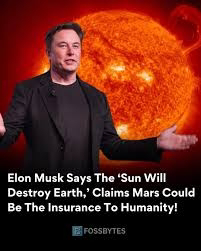
Elon Musk’s Vision: Colonizing Mars Before the Sun Destroys Earth
Humanity’s future has always depended on its ability to look beyond the horizon, and Mars now stands as the last great refuge in Elon Musk’s vision of survival before the Sun’s distant destruction of Earth.

Elon Musk has long been an advocate for space exploration, but his ambitions go far beyond launching rockets and satellites.
The billionaire entrepreneur sees Mars as humanity’s ultimate insurance policy—a refuge for civilization before Earth meets its inevitable fate.
According to Musk, the Sun will eventually expand and engulf our planet, making life on Earth impossible. While this catastrophic event is billions of years away, he believes we must act now to ensure the survival of our species.
The Threat of the Expanding Sun
The scientific community agrees that the Sun will eventually evolve into a red giant, expanding to a size that could swallow Mercury, Venus, and possibly Earth.
This transformation is expected to occur in approximately **five to six billion years**, but Musk argues that waiting until the last moment is not an option. Instead, he envisions a future where humans become a **multi-planetary species**, reducing the risk of extinction from cosmic or environmental disasters.
Mars: Humanity’s Backup Plan
Musk’s company, **SpaceX**, has been working tirelessly to develop the technology needed for interplanetary travel. His **Starship** rocket is designed to transport humans and cargo to Mars, laying the foundation for a self-sustaining colony.
Unlike previous space missions that focused on exploration, Musk’s goal is to establish a **permanent human presence** on the Red Planet.
He believes that Mars must become **self-sufficient**, meaning it should be able to support life without relying on constant supplies from Earth.
Challenges of Colonizing Mars
While Musk’s vision is ambitious, the challenges of colonizing Mars are immense. The planet’s harsh environment, extreme temperatures, and lack of breathable air make survival difficult.
Scientists and engineers must develop advanced **life-support systems**, sustainable food sources, and efficient energy solutions to make long-term habitation possible.
Additionally, the psychological and social aspects of living on another planet must be considered—how will humans adapt to isolation and the absence of Earth’s familiar landscapes?
The Timeline for Mars Colonization
Musk has set **bold deadlines** for his Mars mission, aiming to send the first humans to the planet within the next decade. While skeptics argue that these timelines are overly optimistic, SpaceX continues to make progress in rocket technology and planetary exploration.
The company has already conducted multiple test flights of **Starship**, refining its design for future missions.
If successful, the first settlers could arrive on Mars by **2029 or 2031**, marking the beginning of a new era for humanity.
A Race Against Time?
Elon Musk’s vision for Mars colonization is not just about exploration—it’s about survival. While the Sun’s expansion is a distant threat, he believes that preparing for the future is essential.
His mission is to ensure that humanity does not remain confined to Earth, vulnerable to extinction.
Whether his ambitious plans will succeed remains to be seen, but one thing is certain: Musk is determined to push the boundaries of space travel and redefine the future of civilization.
For a deeper and more updated exploration of humanity’s scientific journey toward Mars, you can read our new feature on the Red Planet’s enduring pull.”
new feature on the Red Planet’s enduring pull
→ https://www.zemeghub.com/2026/02/red-horizons-humanitys-longing-for-mars.html